The Great Taking: Your Portfolio Is a Promise
David Rogers Webb's dossier on the quiet expropriation. A review for everyone with something to lose, and a monkey who already knows the ending.
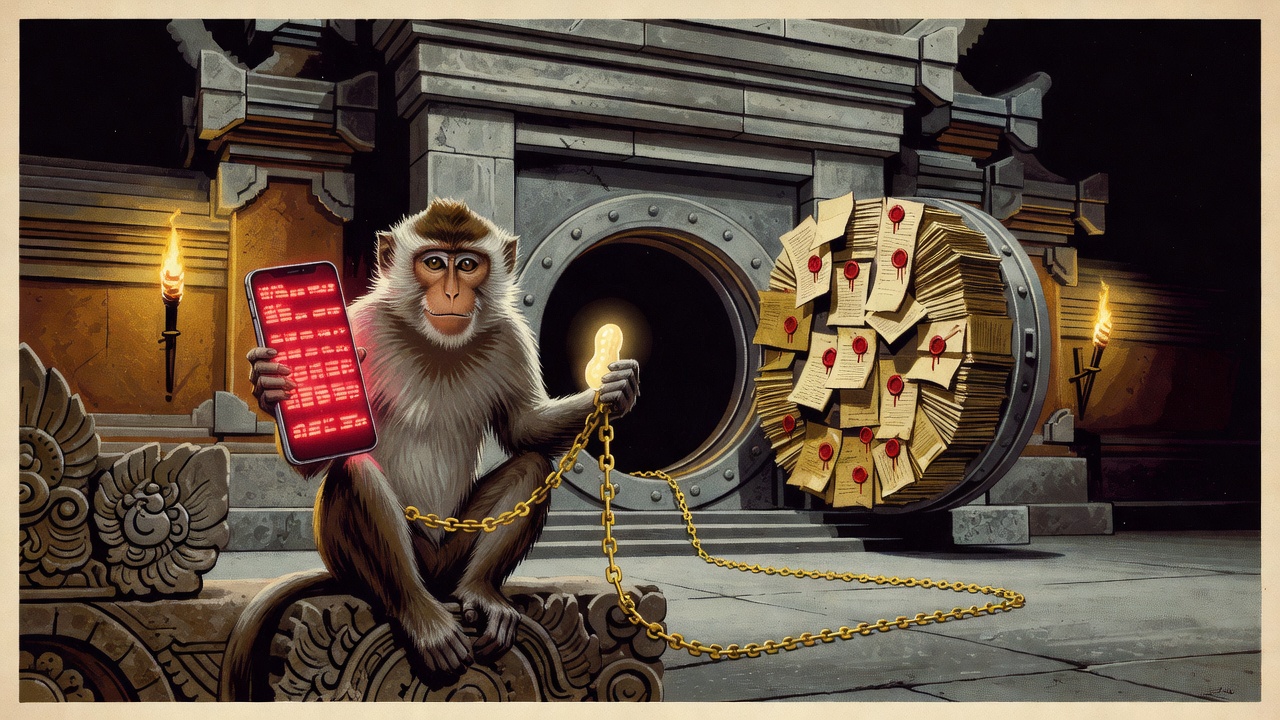
The revolution was never going to eat its children. The backoffice was.
The temple school
Where does a man learn the most about property? My latest field trip says: Bali, from the long-tailed macaques.
Three tribes of them share the temple grounds near Ubud, in a state of managed rivalry; fights and injuries are routine. Hold out a peanut and they are already reaching for the next one; for that they will smile at you and sit on your shoulder. Look away for a second and they strip the whole bag of peanuts and banana slices out of your hands. Try to take it back and you meet aggression; the monkey world knows robbery and extortion in every dialect. And if one of them steals your phone, you are in for a negotiation whose outcome depends on the monkey knowing exactly the price of the stolen good. He behaves like the bazaar in Marrakesh, because he is running the same economics: possession, leverage, and your impatience.
The lesson transfers, and it transfers upward. The thing you actually hold in your hand has a different value than the thing that merely belongs to you. In quiet years the difference reads as pedantry. In crisis years it reads as the whole balance sheet. When the crash flickers back into the headlines, wealth multiplication gives way to wealth preservation, and the boring bank account and gold suddenly outbid the hottest stock and the steepest new coin; or, at the end of the chain of abstraction, a handful of peanuts that really are yours.
Which brings us to the book, because it is the fullest map yet of who holds the peanuts.
The dossier
David Rogers Webb managed hedge funds; he writes like a man who has read the prospectuses so you do not have to. The Great Taking is a short book with a thick thesis buried in it: we sit inside a gigantic, legally and technocratically prepared attempt at expropriation. Not torches and seizure squads; PDFs, clearing structures, and definitions of ownership so arid that the healthy mind switches off while reading them. That switch-off, Webb argues, is the load path of the whole project. The dryness is the camouflage.
It is not a thriller and not a doom pamphlet. It is a dossier: contracts, amended statutes, collateral rules that nobody reads and everybody signs. You do not have to buy his every conclusion to accept his method. The system he documents was simply never built for maximum citizen freedom, and the footnotes prove it. We have been living under conditions we agreed to without ever reading; the book is the first honest set of notes about what we initialed.
Property without things
Webb starts where most readers bail: dematerialization. Your stocks, bonds, and fund shares no longer exist as certificates with your name on them. They exist as positions in a ledger, and the ledger has a chain: customer, intermediary, intermediary, central depository. At the end of the chain stands an entity that is not you.
The moment ownership becomes a booking, the legal question shifts from the relationship between a person and a thing to the relationship between you and a queue of institutions. And the alarm follows directly: whoever rules the definition of a security claim rules, in a crisis, who is left holding nothing.
The modern financial system sells you safety with one hand, segregated accounts, fiduciary custody, your assets are legally ring-fenced, and builds, with the other, the legal infrastructure under which exactly that ring-fencing becomes a matter of interpretation on the day it matters. A security claim is, as the name finally admits, a claim. It is not a vault key.
The court has heard this case before, in September, under an older name: possession against property. Proudhon’s distinction, the user versus the deed-holder, was written for the industrial age; Webb documents its financial-age refinancing. The collateral is the buffet. The legal terms are the knife.
Harmonization, the wrecking ball
The sharpest pages are on harmonization: global standards, uniform rules, efficiency for the markets. On the regulators’ slides it looks like stability. In Webb’s reading it is the unification of access points.
When every market ticks the same, every contract reads the same, and every collateral position is defined the same, the great access needs one central decision instead of a thousand local legal fights. States, courts, individuals: all plugged into the same infrastructure, owned by none of them. Whoever shrugs here has not watched the pandemic regimes, the sanctions regimes, and the payment-network shutdowns of recent years closely enough. The toolkit exists. Webb’s claim is the stronger one: it was built to be used.
Choke points and holidays
Where the book turns from analysis to warning: collateral management, central clearing parties, bank holidays. Collateral pledged and re-pledged up the stack; risk leveraged under the floorboards; a handful of CCPs operating as the nervous system of the markets. Officially the CCPs are the stability anchors. In Webb’s logic they are the perfectly centralized choke points: whoever controls them controls who counts as liquid tonight, and who wakes up defaulted.
Bank holidays, frozen accounts, temporary access restrictions: none of this is speculation; it is rehearsed practice from 2008 through Cyprus to the last currency shocks. Webb assembles the pieces into a scenario for the next great stress event, crash, war, monetary shock, in which what gets rescued is not your money and not your assets but the ownership order itself, shifted toward the intermediaries and the creditors. You keep the risk. They keep the things.
And his most interesting coinage names the endgame: the Great Deflation. Not falling prices; a systemic devaluation. Wealth that rests on credit-driven bubbles is wound down by law and by ledger, politically and juridically, such that the real values land in concentrated hands and the rest of the population is left holding claims, promises, and digital receipts. A deflation of sovereignty: property shrinks, claim-structures grow, and the citizen ends up as a second-class creditor navigating the beautifully designed interface of a system that no longer knows him as an owner.
The paranoia audit
Is this too much paranoia? Run the check the way the book earns it: by method, not by tone. Webb worked through statutes, rewrites, and clearing rules that no layman reads and that bind every layman. The conclusion does not require his every inference; it requires only the observation that this architecture was not designed for your freedom, and that its emergency features have already been exercised, selectively, on entire countries and payment networks.
For anyone who lived the last few years with open eyes, frozen accounts, deplatforming, sanctions arithmetic, the social technology of compliance, the book produces not a foreign feeling but a déjà-vu. It is not written for conspiracy tourists. It is written for people who read the footnotes before they park their life’s work on somebody else’s blockchain.
The counter-protocol
Webb stops short of the apocalypse and hands out recommendations that are banal, which is exactly why they are radical:
Education. Understand the system your money lives in. Whoever does not know the terms is not advised; he is administered.
Diversification. Not everything in the bank silo. Physical values, decentralized structures, real things. Things, note the word.
Community. Resistance is not a solo project. Local networks are not romance; they are the oldest reliable infrastructure there is.
Critical thinking. Do not adopt a narrative for its layout quality.
That is not survivalism. That is intellectual hygiene.
The exit tradition adds the floor Webb leaves implicit, because a counter-protocol without a foundation is just a mood. Possession by use: what you hold, control, and can carry is yours; what a registry says about you is a claim, and claims get re-priced. Opacity by default: your balances and plans are nobody’s inventory. Self-custody as the possession test: keys in your hand, metal in your vault, skills in your body; the drill, not the statement, decides whether you own it or merely supervise it for someone else. And the door: the right to leave with your energy and your reputation intact, the one constraint that makes every other line of defense real. A fortress the grid built around your property is not your fortress.
The verdict
The Great Taking is no literary masterpiece. It is a necessary irritant. It forces you to take the unremarkable bureaucracy of the global financial system seriously as what it potentially is: the stage directions of a silent expropriation.
Whoever closes the book still believing his greatest risk is Bitcoin’s volatility has not understood the program. The greatest risk sits in what politeness calls system trust, and Webb’s contribution is the demonstration that this trust has already been pledged as collateral.
You do not need to adopt his conclusions as dogma. Read it before others decide about your property while you still believe it is yours. The monkeys of Ubud could have told you: the negotiation goes better when the peanuts are in your fist.
Source: David Rogers Webb, “The Great Taking” (2023); after the German review essay “Die große Enteignung durch die Bürokratie” (CREDO newsletter, September 2026).
Related: The Skimmed Individual · Mutualism: possession against property · The Etymological Court