The Skimmed Individual
Wealth is stored energy, and the state is a grid that knows it. Notes on keeping your own power on while the system contracts.
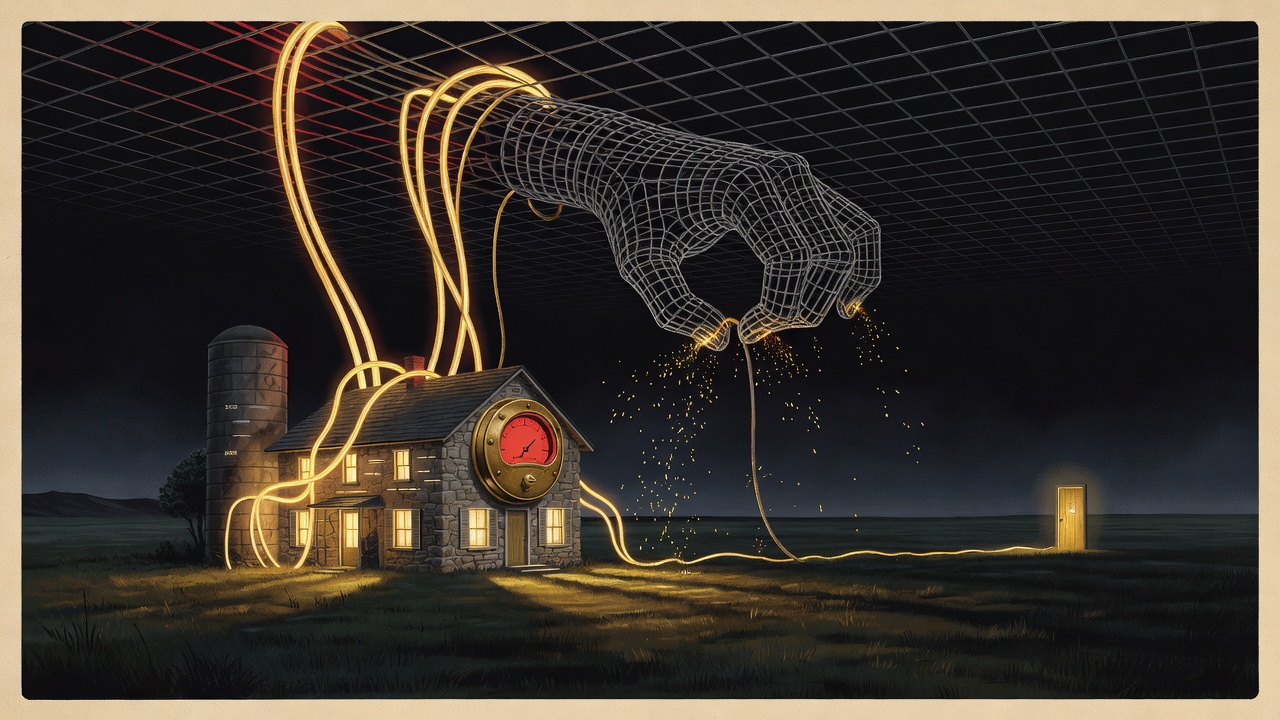
Think today on tomorrow and on many days. For the cautious there are no accidents, and for the attentive no dangers. Do not postpone thinking until you stand neck-deep in the mire; it must happen in advance. The pillow is a silent oracle: to have slept on an undertaking beforehand is better than to lie sleepless over it afterward.
Baltasar Gracián, The Art of Worldly Wisdom
Wealth is stored energy
The German word for fortune is Vermögen, and it is the noun of a verb: vermögen, to be able. The language remembers what the investment brochures forgot. Wealth is not a pile; it is a battery. It is surplus energy, harvested from labor, luck, or catastrophe survived, stored against the day you need to draw on it.
Count the battery honestly and it has three cells. The monetary one: money, gold, bitcoin, the claim tickets you can carry. The competence one: talents built out, skills acquired, the things your hands and head can do that others will pay for, barter for, or follow. The social one: family, friends, a mesh of the like-minded, where the exchange rate of energy is something no central bank prints. A fortune is all three cells charged, because in a crisis the cells convert into each other or they are not charged at all.
Managing that battery is the actual discipline. Everything else in this essay is its operating manual.
Contraction, then extraction
We live inside a system change: a late democracy degenerating into an authoritarianism with a human face, its hieroglyphs already on the wall while the new system behind them is still being poured. And here is the mechanical law the comfortable miss: a state in contraction does not relax its grip; it tightens it. The old powers mobilize every calorie left in the machine. Contraction of authority is followed by extraction of energy. It happens centimeter by centimeter, and financial freedom dies the way anything dies centimeter by centimeter: deniably. In wartime the pretense stops and all energy flows one direction, into the machinery.
You can read the direction in any newspaper, on any day. A little more control here, a little more transparency there; a new register; property taxes quietly raised. For those who want out: the exit tax, the toll booth on the door itself. Brussels meanwhile works on the savings of citizens, the famous lazy money sitting in accounts doing nothing, and wonders aloud how to route it into investments. First the incentives, then, if history is any guide, the war bonds. From 2027, EU citizens may no longer hold a foreign account at a bank without an EU branch; the perimeter fence gets a legal paragraph. And if you wonder what the state does with the data you entrust to it, France just answered: a finance ministry employee sold the list of the country’s largest crypto holders to the mafia. Raids followed. Kidnappings followed. The founder of a French bitcoin company lost a finger to his captors.
Ask what you may safely tell the state about yourself, and the honest answer is now a data hygiene rule: nothing you would not hand a criminal, because that is occasionally the same recipient.
The farm
Strip the civics-class varnish and the relationship between citizen and modern state is the relationship between livestock and farmer. We are all on the farm together, and the farm is run on two iron rules.
The first: the state creates no net energy. It never has. The generator, the converter, the surplus-maker is always the individual, alone or organized with others. The state is a grid, and a grid only transports.
The second: the grid is engineered so that your energy never leaves it. Every gain you make is to be skimmed; every monetary loss you suffer is to be prevented, because a lossy battery is a battery someone else has to subsidize. Want out? Buy yourself free, and land in the next system, which noticed your arrival fee and has raised it; the truly stubborn take up the perpetual traveler’s life and render themselves administratively homeless on purpose. Thermodynamically, the design goal is elegant and total: the citizen’s energy ideally never exits the state’s closed loop.
Sovereignty, against that, has a precise definition: control over your own energy budget. That budget decides your range of motion, your set of real options, your degree of self-command. The only open question, the one this century is busy answering, is whether technology becomes a liberation tool or a continuation of the farm by other means.
The audit
Effective protection of stored energy begins with a sober balance sheet, asked before the crisis grades it for you:
What is actually mine right now? Not registered to me, not associated with me: mine.
What is only a claim? A balance at a bank is a promise made by an institution, and promises are re-priced exactly when you need them most. A title in a registry is a line in a database maintained by the same organism doing the skimming.
What do I hold in self-custody? Keys in my hand, metal in my vault, skills in my body, documents under my roof. This is the cell that survives a registry outage, a bank holiday, a border closure.
What can I actually mobilize in a crisis? The honest test is not the portfolio statement; it is the drill. If you have never moved it, tested it, carried it, you do not own it; you supervise it for someone else.
What must I learn now? Of the things I will soon need, competence, jurisdiction, language, craft, which ones are still cheap to acquire this year? Learning is a market like any other, and its prices spike precisely when everyone discovers the shortage at once.
Marcus Aurelius located the control of a life largely in the control of one’s own thoughts, which is why the modern battlefield has extended into exactly that territory. State-corporate thought management is the keystone of the whole architecture: dominance over a man first immobilized in his options and then colonized in his head. Guard the inner cell like the outer ones.
Forethought
Gracián’s counsel stands because the economics underneath it stand: foresight is cheaper than aftercare. A thought spent on the future this evening costs minutes; the same lesson bought after the mire is at your neck costs years. The pillow is a silent oracle; sleep on the undertaking before it, so you are not sleepless over it after.
And there is a life after every system change. The only open variable is the energy level at which you live that life. Whoever refuses to lose options later must enlarge them now, because optionality, once lost to the grid, is bought back at panic prices if at all. Crisis has chaos in it by definition; the core competence is agility. No plan survives first contact; adaptation does. But note the order of operations: adaptation is a capability you build before contact, with exactly the energy you still have now.
Whoever will not tend his own range of options at all has already surrendered his sovereignty; that is the one unconditional loss, and it is voluntary.
For everyone else, the race is open.
The door
The exit tradition this blog keeps has a name for the whole pattern above, and a floor under it. Opacity by default: your data, your balances, your plans are nobody’s inventory. Possession by use: what you hold and use and can carry is yours; what a registry says about you is a claim, and claims get re-priced. And the door: the right to leave, with your energy and your reputation intact, is the single constraint that makes every other protection real, because a battery the grid can fence in is already the grid’s battery.
The state in contraction will read this essay as a manual for livestock. It was always going to. The farmer’s error is older than the farm: he believes the energy is his because he built the fence around it.
The energy was never in the fence.
Source: after Milosz Matuschek, “Die Befreiung des abgeschöpften Individuums” (CREDO newsletter, September 2026); rewritten and extended along the Exitarian axioms.
Related: The Great Taking · The Post-Liberal Path · The Etymological Court