The Etymological Court #6: Mutualism
Reciprocity, not rent: the weavers' word for an economy without a master.
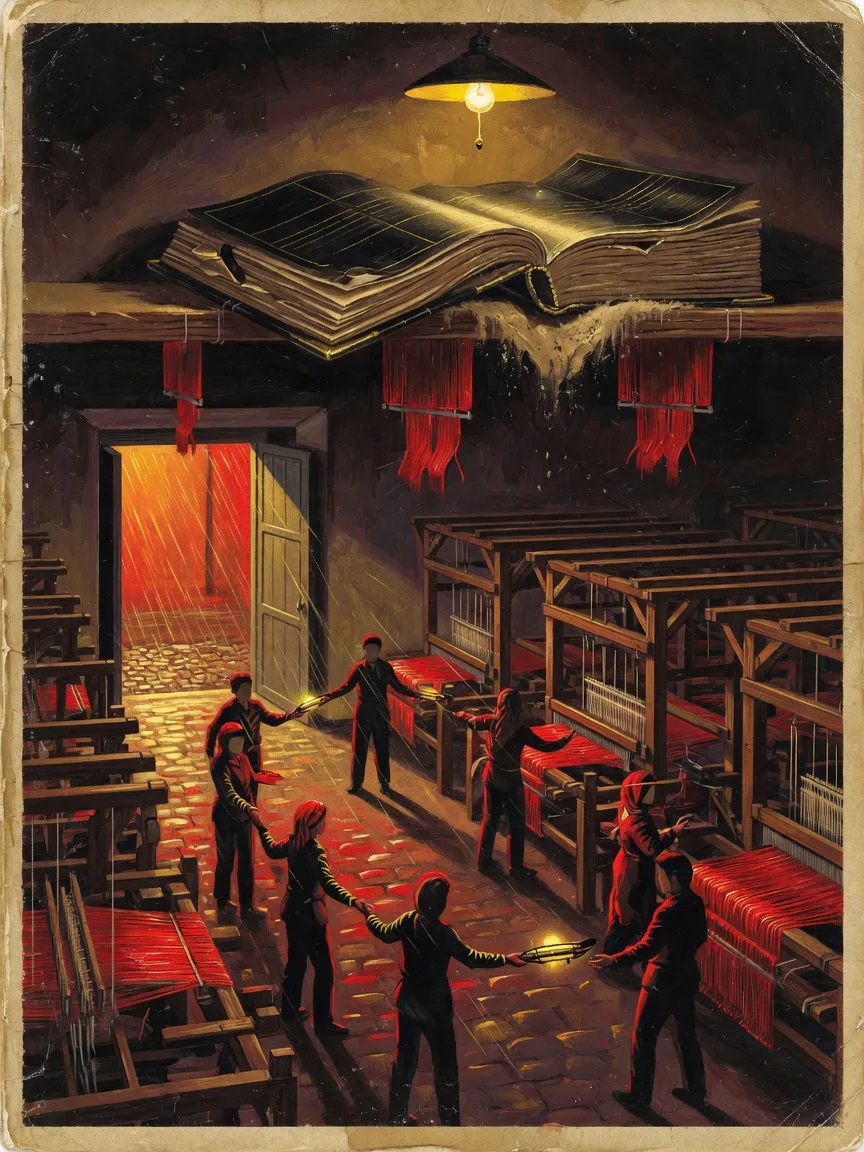
The weavers of Lyon wanted exchange without usury and work without a master. A century later, the usurers claimed the word.
The Word
mutuus. Latin for in return. For reciprocal. Roman law called the loan a mutuum, the thing handed over with the promise that an equivalent comes back. The root carries an entire economics: no gift without a return, no taking without a giving, no debt that must become a leash. Mutual is the adjective for people who owe each other equally.
The word reached politics through nineteenth-century France. In Lyon, the silk weavers, the canuts, had built sociétés de secours mutuels, mutual-aid societies that pooled sick pay, strike funds, and wages, and organized cooperative workshops that negotiated their own prices. When Proudhon moved to Lyon in 1843, he found reciprocity already working; he took their word for it. He spelled it his own way, mutuellisme, and made it the engine of his economics. The name, before the theft, meant one thing: an economy of fair exchange, where no one is paid for doing nothing.
What It Wanted
Charity first. Read at its best, mutualism is the gentlest radicalism ever drafted. No seizure of the state. No guillotine. No vanguard. Its weapon was the contract, kept. Its strategy was to dissolve exploitation from inside the market, peacefully, by making exchange genuinely reciprocal.
Four convictions carried the first school:
1. Reciprocity. Every exchange at true value: a day’s labor for a day’s worth, a thing for its equivalent. No middleman’s margin.
2. Possession over property. Use-based control rather than title-based exclusion. The person who works the land, runs the machine, inhabits the house, they hold it, because they use it. The deed held by someone who never sets foot is the theft.
3. Cooperation. Workers owning their own shops, with no boss between the work and the reward.
4. Credit without interest. Capital as a common service, not a toll booth. A worker should borrow to start, and pay back what was borrowed, not rent on the loan.
Not a program for tearing the world down. A program for the world to stop stealing.
Why It Mattered
Because industrial capitalism had produced a new species of absurdity, and mutualism aimed at its root. The worker built the factory, ran the looms, produced the silk, and owned none of it. The owner held the deed and did none of it, then collected rent on the difference. Wage labor wore the mask of contract while behaving like serfdom: freely entered, catastrophically difficult to exit. Usury took the same shape: a loan extended like a hand, then a chain, as interest compounded against the borrower’s future.
Capitalist property was the lock that held it all shut: the deed that let the idle collect from the active, legally, forever. Mutualism answered a question nobody else was asking: what if the person who uses the thing owns it? Not what if the state owns it. Not what if the market somehow compensates it. What if they did.
The First School
Proudhon published What is Property? in 1840. Its opening verdict is the most famous in the history of political economy: “property is theft.” Theft not because possession is wrong; possession is the just, use-based control of what you work. Theft because property, in the legal sense, is the right of the absentee to live off the labor of the present. The one who works holds it by use. The one who merely holds the title has already stolen.
The Lyon weavers had been living this doctrine before Proudhon gave it a name. The canuts struck, organized, pooled, and cooperated, and their mutual-aid societies were mutualism in practice. Proudhon theorized what they were already doing, then pushed it further: mutual credit, the People’s Bank of 1849, which would lend at zero interest, financing cooperatives and exchanges so that no worker ever needed to borrow on a usurer’s terms. It failed; he was arrested, the bank folded. The architecture survived anyway, in every credit union that came after.
The doctrine was precise: voluntary cooperation, fair exchange, possession through use, mutual credit. Peaceful economic transformation from inside the market, not the abolition of exchange, but the abolition of the cheat hidden in it.
Possession, not property. Why the distinction is not a loophole.
The objection arrives immediately and predictably, from every lawyer, landlord, and heir with a stack of deeds. What about inheritance? The trust for an unborn child? The corporation that holds title collectively for thousands of shareholders? Does your use-criterion abolish the will, the family, the joint-stock company, the pension fund?
The use-criterion is not a sledgehammer. It is a distinction. Property, in Proudhon’s mouth, is the right to extract value from a thing without using it; that is the theft. Possession is the right to use a thing without being dispossessed by someone who does not. The two questions the criterion asks of every title are simple, and they close most objections by themselves:
Who uses it? If a person uses a thing, they hold it by possession, and that possession is inviolable. Inheritance survives this easily: a son who farms his father’s land uses it, therefore possesses it; the title descends because the use descends. A trust for an unborn child survives it: the trustee holds in trust for a future user, and the doctrine holds trustees to the same duty of use they always had, forbids them from extracting rent during the minority, and treats the trust as stewardship, not absentee dominion.
Who does not use it? If a corporation holds title to a factory while renting it back to the workers who run the looms, the criterion asks the second question. The workers use the factory. They possess it. The corporation, by definition, does not. The rent the corporation extracts is the theft Proudhon named in 1840, regardless of how many shareholders signed the paperwork. The joint-stock company that employs zero people and collects rent from many is the institutional form of the absentee deed, and the use-criterion strips it naked.
The distinction also handles a case the squatters hope you will not ask. The absentee heir. The heir who never sets foot on the land, who collects the inheritance check, who treats the family farm as a quarterly dividend. Proudhon would have called him what he is: a property owner, not a possessor, and the law the doctrine proposes would treat his claim accordingly. He may be compensated for the improvements his title financed; he may not collect rent from the cousin who actually plows. The family does not require absentee ownership to survive; it requires respect for the use.
That is what the first school meant when it wrote possession and property as opposites. The use-criterion is not a slogan. It is the firewall that lets inheritance, trust, and the family firm stand, and the chisel that breaks the absentee deed, the rentier corporation, the heir-by-paperwork. Squatters hate it because it points at them.
Proudhon is the hinge figure of the nineteenth-century anti-statist left, and the mutualist, the anarchist, and the syndicalist all claim him as ancestor. What unites them is the refusal of absentee property and the wage relation; what divides them is whether to abolish the state, abolish capital, or abolish exchange. All three descend from him, but the lineage has a chronology the court insists on: mutualism is his own doctrine, direct from his pen; anarchism arrived through Bakunin, the man who called himself Proudhon’s political heir and fought Marx for the soul of the First International; and the syndicalists built a generation later still, from Bakunin’s inheritance. None of them has a monopoly on his name. He is the man who wrote mutuellisme into politics; that is the title the court grants him, and the others must share.
The doctrine was precise: voluntary cooperation, fair exchange, possession through use, mutual credit. Peaceful economic transformation from inside the market, not the abolition of exchange, but the abolition of the cheat hidden in it.
What Happened
The usurpers arrived wearing a genealogy. The anarcho-capitalists claim Proudhon as their ancestor, and use his name to defend the two institutions his entire theory was built to abolish.
Proudhon called property theft. The squatter calls property the foundation of civilization. Proudhon wanted the interest rate abolished. The squatter calls interest the reward of time, the motor of progress. Proudhon wanted the wage contract replaced by cooperative ownership. The squatter calls wage labor freedom itself. They keep the lineage and empty the content, then pour the market back in.
The dilution did the rest. “Mutualism” became a nostalgia brand: an old-timey word for a handshake economy, a folksy prequel to free-market capitalism, safely dead and easily quoted. The weavers who built it would not recognize their own word, and when the first school would not recognize its own name, the name has been stolen.
The Verdict
Mutualism = voluntary cooperation, fair exchange, and possession through use. Anti-capitalist cooperative economics. Wage labor and usury are the crimes it was written to answer; defending them under Proudhon’s name is not lineage, it is grave robbery.
The first school wins. The weavers of Lyon get their word back. The interest rate is a verdict on the squatter, not a pillar of the doctrine.
The Door
Can they leave?
A cooperative economy’s honesty is the door. A worker can quit her cooperative, sell her share, walk out with her reputation intact, and the cooperative must answer for the loss or accept it. A cooperative you cannot leave is a cooperative in name only, which is why mutualism never needed a prison to explain itself.
Now apply the same test to the two instruments the squatter defends.
Usury is a lock. A compounding debt is a door that only swings one way; the lender’s exit is guaranteed, the borrower’s is a fantasy. The wage contract under one boss may be quit, but under an economy where every door is a loan you cannot repay, exit is the illusion that makes extraction stable.
Mutual credit is a door. You borrow to start, you repay what you borrowed, and you walk out free; the debt, by design, does not outlive the use. That is the difference between a toll and a threshold. The first school built the threshold. The squatter sells the toll.
The weavers of Lyon could walk out of their own workshop. That is why their mutualism was real, and why the word, at its root, mutuus, in return, still means what it meant: a world where taking obliges giving, and no one is chained to a debt they cannot leave.
Series: The Etymological Court · Previous: Conservatism · Next: Syndicalism