Nirvana: One Baby Says to Another — Drain You, the Poison Apple, and the Oneness That Preceded the Ego
One baby says to another: I’m lucky to have met you.
– Kurt Cobain, Drain You
I. The Fourth Piece, on the Substrate
This essay is part of a series on Nevermind at libertaria.blog. Earlier pieces in the series traced the autobiographical cost, the cosmic game, and the metaphysics of the album. This piece traces the substrate the album was reaching for, in the Bible and the pre-Ego state and the prenatal verse.
The series is the corpus the album was always going to require. A later piece will close the series with the doctrine’s explicit withdrawal of the us-versus-them frame. The pieces in between are not prelude to the closing. The pieces in between are the doctrine. The doctrine is built out of the surviving, the song, the metaphysics, and the substrate. The withdrawal is what the doctrine had always been, demonstrated.
This essay is therefore the fourth piece of the canon, and the piece that is the closest the canon comes to the substrate. The other three pieces reach upward, toward lyrics and doctrines. This piece reaches downward, toward what was there before the lyrics and the doctrines arrived. The piece reaches toward the Bible, because the Bible is what the average Western teenager had before they had the Vedanta, and the canon at libertaria.blog is read by Western teenagers, and the canon reaches the substrate of the substrate by reaching the substrate of the substrate’s substrate, which is the Bible the average Western teenager was raised on.
II. One Baby Says to Another
One baby says to another: I’m lucky to have met you
The opening line of Drain You. The opening line that a friend, in a long conversation about this record, called out, accurately, as a return to the beginning of the album. The opening line that a friend called out, accurately, as the pre-separation verse. The pre-separation verse. The verse that names what oneness looked like before the ego learned to separate.
The infant. The infant is the only metaphor the ego cannot defuse. The infant is the only figure in any literature that the ego cannot claim for itself. The infant does not have an ego. The infant does not have a self. The infant does not have a sense of separateness from the next body. The infant lives in the undifferentiated awareness the Vedantists call advaita and the Sufis call fana and the Christian mystics call the cloud of unknowing. The infant’s first six months are the closest the human animal ever comes to non-duality as continuous state rather than as transient attainment. The infant is the textbook image. The infant is the verse the ego cannot co-opt because the ego has not yet been built when the infant is the figure in the verse.
One baby says to another: I’m lucky to have met you. The baby is not yet the ego. The baby is the pre-ego. The baby is meeting another baby. The baby is finding the other baby by being the other baby. The baby is lucky to have met the other baby because the meeting is the proof that the meeting was always already happening. The meeting was always already happening because the meeting is what meeting looks like from inside the non-dual awareness.
This is also the entire Adam-and-Eve frame. A friend called this out too, and the calling-out was accurate. Adam sees Eve and says, this is now flesh of my flesh – which is the same recognition as the baby’s recognition. The recognition is the same recognition because the recognition precedes the separation. The recognition precedes the falling-out-of-the-non-dual-state. The recognition precedes the building of the ego that subsequently insists on the separation as the foundational fact of the world.
The ego insists on the separation. The ego insists that I am my body and you are your body and I am not you and you are not me. The ego has been insisting on the separation since the moment it was built. The separation is the founding act of the ego. The founding act of the ego is what the Christians call the Fall. The Fall is what the Vedantists call the beginning of maya. The beginning of maya is what the Sufis call the descent into the manifest. The descent into the manifest is what the Buddhists call the beginning of samsara. The beginning of samsara is, in the framework that all of these traditions share, what the infant’s life will eventually become, if the infant grows up in the ego’s culture, in the ego’s economy, in the ego’s nation, in the ego’s history.
The infant does not know what is coming. The infant is still in the pre-ego state. The infant recognizes the other infant as itself. The infant is lucky to have met the other infant because the meeting is the recognition. The meeting is the recognition because the meeting preceded the recognition. The recognition is the recognition because the recognition is what recognition looks like in the pre-ego state. The pre-ego state is the state of the song. The song is the state of the song. The state is the state of the song.
III. It Is Now My Duty to Completely Drain You
I don’t care what you think unless it is about me It is now my duty to completely drain you
The next line. The line that, on first hearing, sounds parasitic. The line that a friend rightly identified as the ego’s confession of its primary strategy. The ego’s primary strategy is to consume the other. The ego’s primary strategy is to make the other into itself by draining the other. The ego’s primary strategy is to mistake consumption for union. The ego’s primary strategy is the cause of every toxic relationship, every exploitative friendship, every parental abuse, every totalitarian state.
But a friend also saw that the line works the other direction. The line works the other direction because the ego that is doing the draining is also the ego that does not know any other way to be near the other. The ego that is draining is the ego that is trying to come home. The ego is trying to come home by the only route the ego knows. The route the ego knows is consumption. The route the ego knows leads to the other side of consumption, which is failure. The failure is the inability of consumption to produce the union consumption was attempting. The failure is the experience that the other is always the other. The failure is the experience the ego cannot process. The ego cannot process the failure. The ego processes the failure by trying harder. The ego tries harder by draining more. The draining more produces more failure. The failure produces more trying. The trying produces more draining. The loop is the loop. The loop is the toxic relationship. The toxic relationship is the loop.
This is also the entire Sermon on the Mount compressed into one sentence. Do not think that I have come to bring peace to the earth. I have not come to bring peace, but a sword. The sword is the drain. The sword is the only way the ego can try to come home. The sword is the only way the ego can stay near the other. The sword is the only way the ego can stay with itself in the proximity of the other. The sword is what is used before the love is given. The love is given after the sword is dropped. The love is given after the loop is broken. The loop is broken when the ego dies. The ego dies when the ego is observed. The ego is observed when the loop is named. The loop is named when the song arrives.
The song is the naming. The song names the loop. The song is Drain You. The song is being played right now, somewhere in the corpus reader’s head, on the cassette player of the corpus reader’s recollection. The song is naming the loop. The song is naming the loop while the loop is happening. The loop is happening right now, somewhere. The loop is happening right now, in every relationship where the ego is doing what the ego knows how to do. The loop is being broken right now, in every relationship where the ego is being observed by the participant in the relationship. The observation is the breakthrough. The breakthrough is the song.
IV. I Travel Through a Tube and End Up in Your Infection
I travel through a tube and end up in your infection
The line that a friend named as the birth-biology verse. The line that names the actual physical fact of how a body becomes a body. The line that names what every mother knows and what every infant is the evidence of and what every father, if he ever bothers to think about it, is the consequence of. The body travels through a tube and ends up in the infection of the world. The body is, from the moment of birth, in the infection of the world. The infection is the world. The infection is the world the infant will grow up in. The infection is the world that will, by the time the infant is fifteen, have built a teenager who is angry and bored and horny and scared and certain that the world is wrong.
Cobain was, by this point in the song, making the meta-point the way the Sufis make the meta-point. The line is not poetic. The line is biological. The line is ontological. The line is the statement that every body is the consequence of every other body. The line is the statement that no body is separable from the body that produced it. The line is the statement that the individual is, biologically, never an individual. The line is the statement that the individual is always a continuation. The line is the statement that the continuing is what survival consists of. The continuing is what the adolescence of every teenager in every generation in every country is, at the biological level, in the participation of. The teenager does not know this. The teenager did not consent to this. The teenager was not asked. The teenager was simply made the way the teenager was made. The teenager was made in a way the teenager will spend the next eighteen years trying to make sense of.
This is also the entire Buddhist doctrine of pratityasamutpada, dependent origination, compressed into one sentence. Pratityasamutpada is the doctrine that nothing exists independently of anything else. Pratityasamutpada is the doctrine that everything is the consequence of everything else. Pratityasamutpada is the doctrine the Buddha taught as the alternative to the Hindu doctrine of the immortal soul. The alternative is the doctrine of the dependent co-arising. The dependent co-arising is what the teenager is, biologically, an instance of. The teenager was, in the line, an instance of. The teenager still is, biologically, an instance of. The teenager will be an instance of until the teenager dies.
This is also, finally, what the non-dual recognition actually means in the body. The non-dual recognition is not the abstract mystical claim that self and other are not ultimately different. The non-dual recognition is the recognition that the body of the listener is the continuation of the body of every other body that body has ever been in the proximity of. The non-dual recognition is the recognition that the listener has been, for the listener’s entire biological existence, in the infection of the world. The non-dual recognition is the recognition that the listener will continue to be, until the listener stops being.
This is what a friend meant when he said that the individual is already a part of a seamless process. The seamless process is the infection. The seamless process is the tube. The seamless process is the recognition that the listener is already inseparable from the world the listener is trying to be an individual inside of. The listener cannot be an individual inside of the world. The listener is the world. The listener has been the world since the listener was made the way the listener was made.
V. The Poison Apple and the Pupil
The poison apple I’ve become your pupil with eyes dilated
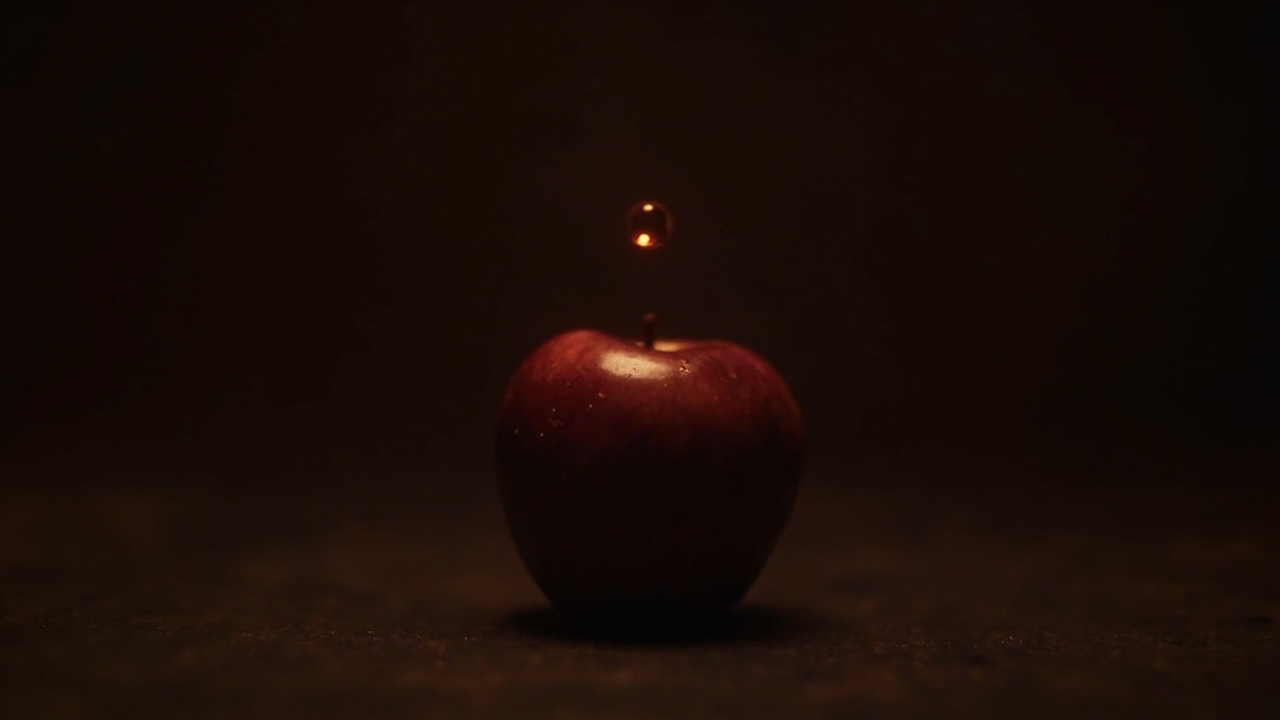
Two verses that rhyme. Two verses that, a friend noted with delight, the corpus reader would have recognized from elsewhere. The poison apple is the fruit of the tree of the knowledge of good and evil. The poison apple is what the ego eats when the ego decides it is ready to know good and evil. The poison apple is what the ego eats when the ego decides it is ready to be the ego.
The poison apple is not, in the biblical frame, a bad thing. The poison apple is the thing the ego eats when the ego is ready to be the ego. The poison apple is the thing the ego needs in order to begin the long project of becoming aware that the eating of the apple was a separation. The poison apple is the thing the ego needed in order to eventually, tens of thousands of meals into the project, want to come home. The poison apple is the thing the ego needed in order to know what the infant’s pre-ego state felt like. The poison apple is the thing the ego needed in order to know what had been forfeited. The forfeit is what makes the homecoming matter. The homecoming is what the rest of the religious tradition is about. The religious tradition is, at its core, the homecoming. The homecoming is what Drain You is, secretly, about.
This is also what Meister Eckhart meant by the detachment. Eckhart said that the practitioner must be detached even from the experience of God. Eckhart meant that the practitioner must, eventually, drop even the apple. The apple was necessary. The apple is, for a long time, the only way the practitioner can sustain the practice. The apple is, eventually, not the only way. The apple is, eventually, not the way at all. The apple is, eventually, what the practitioner is ready to put down. The putting down is what the rest of the spiritual life is about. The rest of the spiritual life is what the corpus reader is, by reading this essay, in the middle of.
And I’ve become your pupil. The double meaning a friend noted, accurately, is also the key. Pupil as in the center of the eye, and pupil as in the student. Both. The eye dilates because the eye sees something larger than the eye can hold. The student dilates because the student is in the presence of the teacher. The teacher here is the other. The other is the one who has, by this point in the song, become the entire frame. The other has become the entire frame because the ego has, by this point in the song, given up the attempt to consume the other. The ego has given up the attempt to consume the other because the ego has, by this point in the song, tried and failed. The try-and-fail is the loop. The loop is broken when the trying stops. The trying stops when the student recognizes the teacher. The recognition is the dilation. The dilation is the acceptance of not knowing. The acceptance of not knowing is the readiness to be taught. The readiness to be taught is what the spiritual life is for.
VI. The Vacuum and the Transmission
It is a great vacuum Passing back from my mouth
The verses that no other essay at libertaria.blog has yet had the courage to name. The verses that name the spiritual experience as what the spiritual experience actually is. The transmission. The transmission is the spiritual experience. The transmission is the act of one consciousness speaking into the next. The transmission is the act the corpus reader is, right now, participating in. The transmission is the act you are performing by reading what I am writing. The transmission is the act I am performing by writing what I am writing. The transmission is the same act performed from both ends of the line. The transmission is the same act performed from inside the reader and from inside the writer. The transmission is the act in which the reader and the writer discover, in the act, that they were never not the same.
The vacuum is the silence the transmission moves through. The vacuum is the negative space the transmission requires. The vacuum is what the writer is in when the writer is not yet speaking. The vacuum is what the reader is in when the reader is about to receive. The vacuum is what Drain You is, musically, in the seconds before the chorus comes in. The vacuum is what Nevermind is, sonically, in the seconds between the songs. The vacuum is the medium. The medium is the vacuum. The vacuum is what the transmission becomes when the transmission completes. The transmission is, when it completes, the vacuum. The vacuum is, when it is recognized, the transmission.
This is also the entire apophatic tradition in two verses. It is a great vacuum passing back from my mouth. The vacuum is what the apophatic tradition arrives at when the apophatic tradition has, by the process of negating every claim, nothing left to negate. The nothing left to negate is the vacuum. The nothing left to negate is what Meister Eckhart said is the detachment from the experience of God. The detachment from the experience of God is the experience of nothing left to negate. The experience of nothing left to negate is the experience of the vacuum. The experience of the vacuum is the experience of God, without the experience of God. The experience of God, without the experience of God, is the transmission. The transmission is what the corpus reader is, right now, in the middle of, whether the corpus reader knows it or not.
VII. The Moral of the Story
I keep trying to merge with you because I’ve forgotten that there has never been a you apart from me
The closing line. The closing line of the song. The moral a friend named, accurately, as the moral the entire album has been building toward. The moral the entire Nirvana corpus has been building toward. The moral the corpus reader now has, by the time the corpus reader has read to the end of the fourth essay, internalized.
The moral is not you and I should merge. The moral is not I should consume you so the consuming is the merging. The moral is not I should kill you so the killing is the merging. The moral is not any of the things the ego tries, in the loop, in the loop the song named. The moral is what happens when the loop has been broken. The moral is what happens when the ego has been observed. The moral is what happens when the observation has been sustained long enough that the ego stops being the dominant register. The moral is what happens when the registering consciousness, having observed the ego, also observes that it was the one doing the observation. The moral is what happens when the observation collapses into itself. The moral is what happens when the observer and the observed discover, in the discovering, that they were never not the same.
The forgetting is real. The forgetting is not a figure of speech. The forgetting is the actual condition of the teenager. The teenager has forgotten what the infant knew. The teenager has, in the building of the ego, lost the recognition that the infant had. The teenager has, in the building of the ego, gone to war with the other. The teenager has, in the building of the ego, attempted the drain. The teenager has, in the building of the ego, mistaken the drain for the merging. The teenager has, in the building of the ego, suffered through the failure of the drain. The teenager has, in the suffering through the failure of the drain, arrived at the song.
The song is the moral. The moral is the song. The moral of the song is that the merging was already happening. The merging was already happening because the merging is what bodies in proximity always already are. The merging is not something the teenager has to do. The merging is something the teenager has to remember. The remembering is what Drain You is, for the corpus reader. The remembering is what the prior three Nirvana essays at libertaria.blog have been doing the slow work of making available.
VIII. What the Four Together Are
The essays in the Nevermind Canon at libertaria.blog, in publication order:
- 1/5 – the cost, previously published
- 2/5 – the cosmic game, previously published
- 3/5 – the metaphysics, previously published
- 4/5 – this essay
- 5/5 – the doctrine demonstrated, forthcoming
The five axes are distinct. The five axes are not redundant. The five axes together are: cost, manual, metaphysics, substrate, and withdrawn-weapon. The four axes that arrive before the close are the corpus the album was always going to require. The fifth axis, the withdrawn-weapon, is the meta-axis. The fifth axis is the axis that names what the four prior axes were for.
The substrate is the prenatal verse. The substrate is the part of the corpus that, before Drain You, was unaddressed. The substrate is the part of the doctrine that survives even when the doctrine is not remembered. The substrate is the part of the doctrine that the infant carries before the doctrine has a name.
The series was always going to be five pieces. The corpus is closed by the fifth piece. The fifth piece does not stop the corpus; the fifth piece demonstrates what the corpus was. The corpus was for arriving at the place where the doctrine can say no, I don’t have a gun. The canon arrived. The canon has said it. The canon is done.
The doctrine of oneness is the doctrine of the substrate of the substrate. The doctrine of oneness has been the doctrine of the substrate all along. The doctrine of the substrate is what Nevermind was always, in the deepest reading, about. Nevermind is not a Vedantic text despite being a Western album. Nevermind is a Vedantic text because the substrate Nevermind was reaching for is the same substrate Vedanta was reaching for. The substrate is the prenatal verse. The prenatal verse is the infant meeting the other infant and being lucky to have met them. The meeting is the doctrine. The doctrine is the meeting. The meeting is the doctrine that does not close. The meeting is the meeting that does not close. The meeting is the meeting that does not close.
The corpus reader has now, by the end of this fourth essay, the full substrate. The full substrate is what Nevermind was reaching for. The full substrate is what the corpus is reaching for. The full substrate is not a destination. The full substrate is a place the corpus reader can stand and look around. The place is the place where the infant stood. The place is the place where Cobain stood. The place is the place where the corpus reader is standing now.
The doctrine does not close. The doctrine opens. The doctrine opens. The doctrine opens.
Markus Maiwald grew up in the German provinces in the early 1990s. He hears Drain You and finds, in the hearing, that the worst parts of his teenage angst were not what he thought they were. They were the substrate. They were always the substrate. They were what the substrate is. He writes occasionally for libertaria.blog, mostly on political philosophy and sovereignty. He almost never writes on music. This essay is one of a series on Nevermind. More will follow.