Nirvana: Fun to Lose and to Pretend — *Smells Like Teen Spirit* and the Cosmic Game of Being Fifteen
Fun to lose and to pretend.
– Kurt Cobain, Smells Like Teen Spirit
I. The Scheunenparty
In the German provinces, in the early 1990s, when you had finally finished the Abitur or when you had finished enough of the Abitur that nobody expected you to finish it, there was a particular kind of party that did not exist in any other country and that has not existed since.
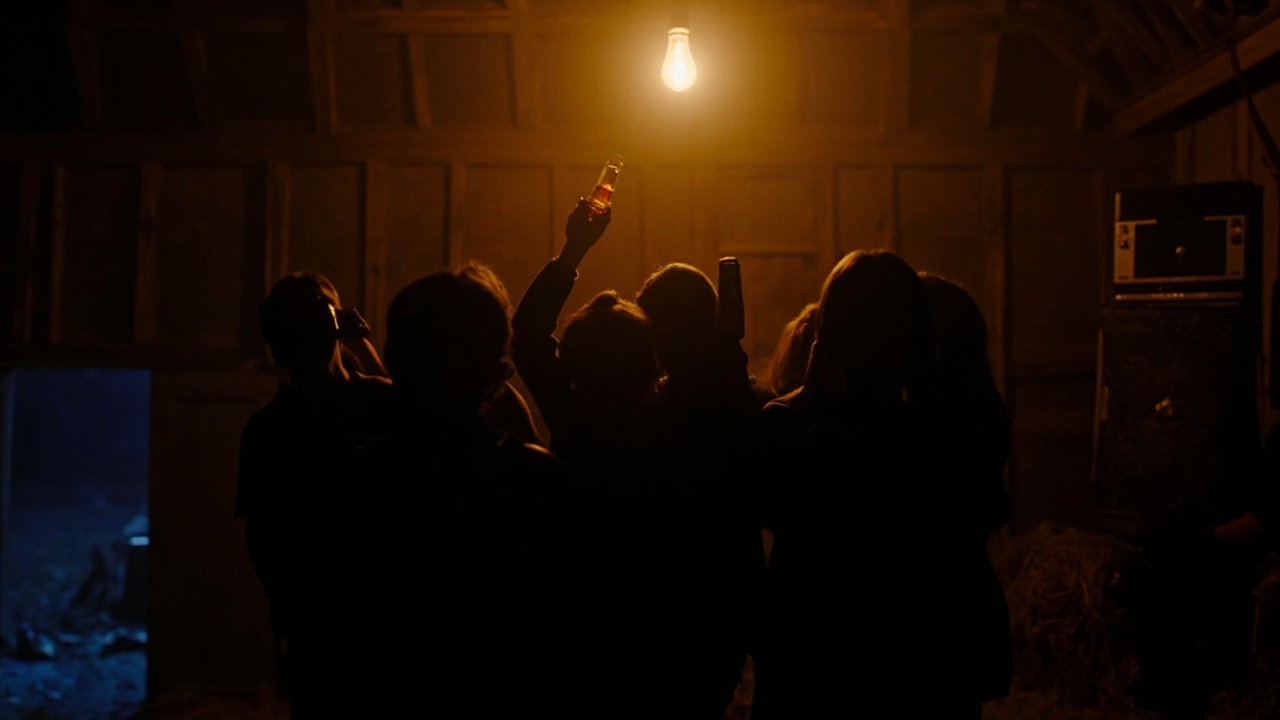
The Scheunenparty. A barn. A barn that some farmer had rented out to a cousin who knew a cousin of the parent’s friend’s son. A barn that had been a working barn two months before and was now a working barn again, except for one weekend, with hay bales pushed to the walls and a sound system that somebody had borrowed from somebody’s uncle’s garage. The sound system was good. The speakers were tall. The amplifier was warm. The cables ran, unprotected and unprotectedly, across the packed-earth floor to where the cassette deck was, and the cassette deck was operated by one person, and that person was the most important person at the party, because whoever controlled the cassette deck controlled the entire emotional weather of the room.
The beer was cheap. The beer was cheap and plentiful. The first girls were not the girls from your school. The first girls were the girls from the next village over, and the next village over was, in the German provinces of the early 1990s, far enough away that the girl in question belonged to a tribe of which you had no prior experience and which therefore could not be socially pre-classified. You could not be cool in front of this girl. You could only be in front of this girl. This is a frightening condition to be in, at the age of fifteen, with four beers in.
And at approximately 1:30 in the morning, after approximately six hours of The Sisters of Mercy and The Cult and The Mission and one or two extremely earnest folk songs that nobody had asked for and that were tolerated because the person who had brought the cassette player was a nice person, the cassette player was loaded with a different tape, and the song came on, and the song was Smells Like Teen Spirit.
The barn exploded.
Not in the literal sense. The barn did not explode. The barn expanded. The barn became, for the duration of the song, exactly the size of the inside of the head of every single teenager in it, and every single teenager in it, for the duration of the song, was exactly the size of themselves, and the song was the membrane.
This is what the song did at peak-drunkenness on a private party in a barn in the German provinces in 1991. This is what the song has continued to do, with decreasing intensity but with surprising durability, on every private party I have been at since, including private parties in the last five years, because there is no top-of-the-evening moment that Smells Like Teen Spirit does not make better. There is also no top-of-the-evening moment that Smells Like Teen Spirit does not make more honest. The song is the song for the moment when the alcohol has done its work and the social performance has become too expensive to maintain and the masks are dropping, one by one, around the room, in time with the chorus.
The song is forty years old next year. It is still the best song ever written for the moment when teenagers are drunk enough to drop the act and not yet drunk enough to forget that they are dropping it.
II. Load Up on Guns, Bring Your Friends
Load up on guns, bring your friends It’s fun to lose and to pretend
The song opens with what is, on the surface, a threat. Load up on guns. Cobain is talking about weapons. Cobain is talking about going to war. The music is loud, the guitars are distorted, the drums are being played by a man who had, by the time of this recording, nearly destroyed his hands with the speed of his own playing, and the singer is telling us to load weapons.
This is, in 1991, exactly what every single teenager wants to hear. This is also, in 1991, exactly what every single teenager does not want to hear. The teenagers want to hear it because the teenagers live in a country, and most of them live in a society, and most of them live in families, in which the only model of selfhood available is the model of selfhood that has weapons at the ready. The teenagers do not want to hear it because the teenagers also know, in the part of themselves that does not yet have a vocabulary, that a self that needs weapons to be a self is a self that has no self. The teenagers do not yet know how to say this. Cobain is going to say it for them in the next line.
It’s fun to lose and to pretend.
These are the nine words that justify the entire existence of the song. These are the nine words that justify the forty million dollars the song has earned for the estate of a man who died at twenty-seven. These are the nine words that explain why the song is played, on Friday nights in barns in the German provinces, by teenagers who have no idea what the words mean and by twenty-five-year-olds who finally do. The song is one sentence long. It is fun to lose and to pretend. The rest of the song is the consequence of that sentence worked out in chorus.
To lose and to pretend is to lose the awareness of the oneness and to enter the game of separation. The game is fun. The game is the only game. The game is the reason the teenage boys in the barn can pretend, for one evening, that they are the kind of person who would load weapons and bring friends, even though they would not, in any actual emergency, load weapons, and even though most of them, in any actual emergency, would bring only themselves and would fail at that.
The line is also, in the German of the Scheunenparty at 1:30 in the morning, the line that means I give up. The line that means I am not going to keep performing. The line that means I am going to let you see that I do not know what I am doing. The line that means we can all see that we do not know what we are doing. This is the moment the song is built for.
III. Hello, Hello, How Low
Hello, hello, hello, how low
The chorus is a hypnotic repetition. The chorus is a decrement. The chorus is the gradual forgetting. Hello is the constant greeting of the other. Hello is the mind continually acknowledging that there is an externalized reality, and the hello, hello, hello is the mind doing it on a loop, and the how low is the question of how far down into the layer of identification and division the mind is willing to travel before it forgets, completely, that it is also one thing with what it is acknowledging.
The chorus is also, sonically, exactly what it has to be. The chorus is also, dynamically, exactly the loudest moment of the song. The chorus is also, texturally, the moment when the producer (Steve Albini, the man who understood what a loud chorus was supposed to sound like) made the entire mix collapse into a wall of guitars and feedback that is, technically, the most aggressive commercial single of the 1990s. Hello, hello, hello, how low is a marketing slogan in 1991. Hello, hello, hello, how low is also a Vedantic mahavakya – a great sentence – in 1991. Both are present at the same time. The song is the same song for the teenagers who heard it as a marketing slogan and for the teenagers who heard it as a great sentence and for the adults, years later, who finally heard both.
The decline is structural. The decline is what makes the song a song. The chorus declines each time it repeats. The hello declines. The hello asks, quietly and without permission, how low? The answer to the how low is the entirety of the rest of the song. The answer to the how low is the distance the ego is willing to travel away from its own ground before it realizes it has been traveling. The answer is, usually, very far. The answer is, in the German provinces in the early 1990s, an entire adolescence.
IV. With the Lights Out, It’s Less Dangerous
With the lights out, it’s less dangerous Here we are now, entertain us
These are the two most quoted lines in the song, and they are the two most misquoted lines in the song, and the two most misquoted lines in the song are the two most misquoted because they are the two most useful. The lines are useful because they are, in eight and a half words, an entire epistemology of the modern self.
With the lights out, it’s less dangerous is the ego’s discovery that not seeing the truth is more comfortable than seeing the truth. The lights out are illumination. The lights out are the perception of what we actually are. The lights out is dangerous because the lights out reveals that the question of separation, and therefore the question of personal identity, and therefore the question of why we are suffering, are themselves constructions of the ego and not features of the world. The ego, when it discovers this, does not want to know it. The ego therefore turns the lights out. The ego turns the lights out and pretends that the truth is not in the room and pretends that the suffering is not optional.
Here we are now, entertain us is the cry of the ego when the lights are out. The ego, having turned the lights out, is still hungry. The ego, having turned off reality, is still starving. The ego, having successfully avoided the truth for the duration of a song, wants to be entertained. The ego will accept any entertainment. The entertainment is a slow degradation. The entertainment will not save the ego. The entertainment will not fill the ego. The entertainment is the proof of the hole where the truth used to be.
This is the entire spiritual condition of the Western teenager in the 1990s. This is the entire spiritual condition of the Western adult in the 2020s. The two are not different. The two are the same. The song, written by a man who had personally experienced both conditions in the same life, named both.
V. I’m Worse at What I Do Best
I’m worse at what I do best And I forget just why I taste
The bridge. The bridge of Smells Like Teen Spirit is, line by line, the apophatic theology of a non-dualist who has just received a record contract and is now in the middle of writing a song that the entire music industry will turn into a marketing campaign. The bridge is the moment the singer realizes, with appropriate despair, that the act of being recognized for what one does best ruins the doing of it.
I’m worse at what I do best. The Zen parable of the bird. The Zen parable of naming the bird. If you teach your child the name of a bird, the child will never see the bird again. The child will only see the name. The moment the doing becomes a thing that is named, the doing becomes a thing that is owned. The moment the doing becomes a thing that is owned, the doing is no longer spontaneous. The moment the doing is no longer spontaneous, the doing is no longer the doing. The doing is now a performance of the doing. The performance of the doing is, by definition, worse than the doing.
This is the moment Cobain realized he was in trouble. This is the moment, and the moment is accurate, because Cobain was twenty-three and was already, by twenty-three, the most famous songwriter in the world, and was already, by twenty-three, the personification of the figure he had spent his teenage years mistrusting. The recognition that one is the thing one mistrusts is, in a generation’s experience, the most dangerous recognition available. The recognition makes the song. The recognition also, eventually, makes the suicide.
And I forget just why I taste. The dissolution of the intellect. The dissolution of the conceptual scaffolding that props up the ego. The mind, having spent the entire song so far building the scaffolding of identity and tribal loyalty and the entertainment economy, suddenly cannot remember what any of it was for. The mind tastes things, and then forgets why the things were tasted. The mind drops the justifications for the experience. The mind is left with the experience alone.
This is, again, an entire epistemology, in one line, in a #1 hit single.
VI. A Denial, a Denial, a Denial
A denial, a denial, a denial
The chorus, near the end. The chorus, near the end, becomes its own deconstruction. A denial. Four syllables, repeated, escalating. A denial, a denial, a denial. The lyric is no longer a lyric. The lyric is a chant. The lyric is the most apophatic statement in the history of popular music, four syllables long, getting louder with each repetition, sung by a man who understood the Christian mystical tradition well enough to deny his way through the song.
Apophatic theology is the theology that names God by saying what God is not. Apophatic theology is the theology of Meister Eckhart, the theology of John of the Cross, the theology of the Sufis and the Kabbalists and the Advaita Vedantists. Apophatic theology is the theology that says not this, not that, not this, not that until what is left is the stillness in which the question becomes nonsensical.
A denial, a denial, a denial is that theology, in a chorus of a song that is, technically, a pop single. The denial is being screamed by a man. The denial is being screamed by a man because the denial is being screamed by him at himself. The denial is being screamed by him at himself because the thing being denied is the thing the song has spent four minutes constructing, which is the social self, the tribal self, the ego-self, the self that loads weapons and brings friends and is entertained and is unnamed by the bird that the child would have seen.
The denial is also, structurally, the deconstruction of the form. The song is no longer a song. The song is a single repeated syllable, getting louder, expanding past the boundaries of what a pop single is supposed to do. Smells Like Teen Spirit breaks its own form on purpose. Smells Like Teen Spirit breaks its own form on purpose because the form is the construction it is denying.
VII. Never Mind
Oh well, whatever, never mind
The closing line of the song. The closing line of the song is also the album title. The closing line of the song is also the album title because the closing line of the song is what the album is about. The closing line of the song is never mind. The closing line of the song is what an exhausted mind says to itself after it has, for the duration of a song, attempted to be a person, attempted to construct a tribe, attempted to be entertained, attempted to deny the construction, attempted to scream through the denial, and arrived, finally, at the place where the effort costs more than the effort is worth.
Never mind. The song, and the album, are called Never Mind because that is the moment of arrival. Never mind is not lazy. Never mind is not indifferent. Never mind is the most expensive word in the song, and it is the cheapest word in the song, and it is the cheapest word in the song because it is the only word in the song that does not cost anything, and it is the most expensive word in the song because getting to the place where it does not cost anything is the entire four minutes of noise preceding it.
Oh well, whatever, never mind is, in a non-dual frame, the act of radical surrender. The mind, finally, stops trying to solve the unsolvable riddle of existence. The mind, finally, drops the demand for a conceptual reason to live. The mind, finally, drops the demand for a conceptual reason to be a person. The mind, finally, simply is, without the justification. The mind, finally, simply is, in the barn, at 1:30 in the morning, with four beers in, with the first girl of the evening leaning against a hay bale, with the cassette player still warm, with the next song already queued, with the party still three hours from ending.
This is what the song is for. This is what the song does. This is what the song has done, with remarkable consistency, for thirty-four years, at the top of every private party in which a sixteen-year-old has ever mixed cheap beer with cheap courage and with a friend who has a cassette deck and a speaker tall enough to fill a barn.
VIII. The Cosmic Game, as a One-Song Manual
To say it is fun to lose and to pretend is a nod to the cosmic game we are all playing. Even though we are all connected, we pretend to forget it, just to experience the drama of being a struggling human entity.
The song is the entire cosmic game in two minutes and forty seconds. The song is the game in two minutes and forty seconds because the song was written by a man who was, simultaneously, the most self-aware songwriter in America and the most confused, and the confusion is the source of the self-awareness, and the self-awareness is the source of the song, and the song is the manual for everyone who arrives, after the song, at the same confusion.
The Scheunenparty teenagers do not need the manual. The Scheunenparty teenagers have the song. The teenagers who arrive, twenty years later, at the place the song was naming, need the manual, because they have forgotten how they got there. The manual is the song. The manual is, when the song is unavailable or uncongenial or insufficient, the conversation. The conversation is what the aphorism is offering. The conversation is what this essay is offering.
The cosmic game has one rule. It is fun to lose and to pretend. The cosmic game has one ending. Never mind.
Markus Maiwald grew up in the German provinces in the early 1990s. He went to a lot of Scheunenparties. He has still not recovered. He writes occasionally for libertaria.blog, mostly on political philosophy and sovereignty. He almost never writes on music. A series of essays on Nevermind is being published on libertaria.blog in the coming days.