Money Without Miners
How Chapter Zero wants to issue hard-backed, anonymous cash, and why it needs no blockchain to do it.
The argument, in brief
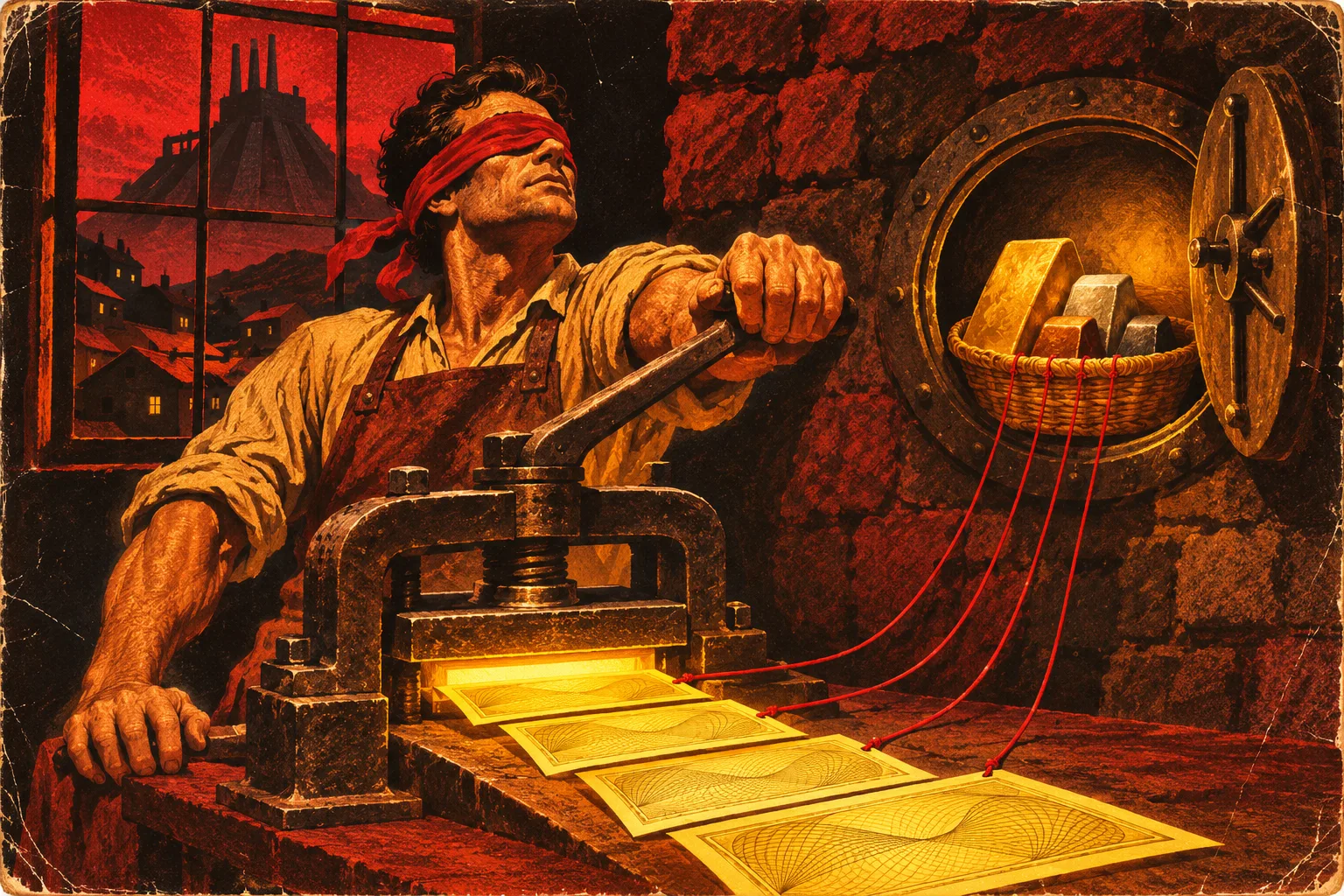
A digital currency has to stop the same coin from being spent twice. Bitcoin does it with a global ledger and miners. David Chaum did it in 1982 with a mint that signs coins without seeing them and keeps a list of spent ones. Chapter Zero builds on Chaum: every note is backed by a fixed basket of the largest coins that nobody can freeze or reverse, the reserve sits in many small vaults, and the group that signs notes holds no reserve. Payments are free and private, totals are public. The design is far along, three areas are under test, and we invite you to attack it before we write the code.
Pay a baker with a five-euro note and you walk out with the bread. The baker has the note. Now imagine you could keep a perfect copy and spend it again at the shop next door. That is the problem digital cash has to solve.
Bitcoin solves that problem with a global ledger and miners to guard it. For the cash we want to issue in Chapter Zero, there is an older answer. David Chaum put it on paper in 1982.
The One Problem Paper Never Had
A digital coin is a number, and numbers copy for free. If I send the same coin to two shops, somebody has to decide which shop got paid. That is double-spending. A paper banknote cannot be in two tills at once; a file can.
Bitcoin’s answer is to have everyone keep the same list of every payment ever made, and to let miners burn electricity for the right to write the next page. It works, and the bill is long. Every payment stays public forever, a page takes ten minutes, and each transfer costs a fee. New coins go to whoever owns the most machines, and two mining pools have at times held more than half of the network’s computing power between them.
Proof of stake, the scheme Ethereum switched to in 2022, replaced the machines with capital: whoever locks up the most coins validates the most blocks. In mid-2025 three operators – the staking pool Lido and the exchanges Binance and Coinbase – held about 40 percent of all staked ether. In both systems fresh money is handed out, block after block, to the people who already hold the most. I find a bank loan easier to defend than a block reward. A bank creates money from nothing too, but somebody owes it back.
The Older Answer
David Chaum, an American cryptographer, solved double-spending in 1982, twenty-six years before Bitcoin. In his scheme a mint signs each coin without seeing it, the way you could sign a letter through carbon paper inside a sealed envelope. When the coin comes back, the mint checks a single thing: has this coin been spent before? It keeps a list of spent coins and holds no accounts and no names. Chaum’s company DigiCash went bankrupt in 1998. The mathematics survived it.
In 2019 a group around the computer scientist Rachid Guerraoui proved the general point in a paper called The Consensus Number of a Cryptocurrency. Payments do not need the whole network to agree on the order of all transactions. Each coin needs its own answer to one question, spent or unspent. Bitcoin puts the entire world’s payments in a single line to answer a question that is local to every coin.
The demand for debits and credits fares no better. Double-entry bookkeeping is a merchant’s tool, written down by the friar Luca Pacioli in 1494 so that Venetian traders could see where they made money. It is good at that. The Dutch tax office does not ask a sole trader for it; it wants records it can check, such as invoices, bank statements and receipts, kept for seven years, in a spreadsheet if you like. Bitcoin itself does not use it either. It tracks unspent coins.
What Chapter Zero Is Drafting
Libertaria is a federation of Chapters – communities of at least thirteen founders who run their own server and write their own rules. Chapter Zero is the first one, ours. What follows is a proposal: a specification with its acceptance tests written and no code behind it yet.
The unit is a basket of currencies. One unit of cash stands for fixed amounts of four coins. The proposal is to take the four largest cryptocurrencies by trading volume that pass one test: nobody can freeze a wallet and nobody can reverse a payment. Bitcoin passes. Which three join it is not decided. Once the open questions below are settled, the Chapter votes on its basket, and every other Chapter chooses its own. The test rules out the large dollar stablecoins and every gold token on the market today. The model is the ECU, the European Currency Unit that preceded the euro from 1979 and was defined as a fixed quantity of each member currency. Fixed quantities mean anyone can work out the value with a calculator. The protocol needs no price feed, and there is nothing for anybody to rebalance.
The reserve is open and the notes are private. The basket holds no privacy coins such as Monero or Zcash, which hide payments by actively scrambling them on their own blockchains. We do not need that machinery, because the note is the private part. Anyone can inspect every vault on a public chain, and nobody can tell who holds a note or where it has been. A note is a share in an open index of coins, much as a share in an exchange-traded fund is a share in a basket of stocks, and it changes hands like a banknote.
The reserve sits in many small vaults. Anyone can run one, for a family or a village. A vault knows two movements: a full basket goes in and cash is issued for it, or cash is destroyed and a full basket comes out. Destroying cash always releases every coin of the basket in its fixed proportion, however small the amount: two notes return a sliver of each coin and never a single one. Any other movement is a robbery, and anyone watching the vault sees it at once.
The press is separate from the vaults. Ten of the Chapter’s thirteen founders sign notes, blind, and only against a proven deposit. They hold no reserve they could take, and a vault keeper has no way to print. I was uneasy about ten people sitting on a growing treasury. In this design no group sits on it.
Paying is free and instant. Every note carries the name of a witness, by default the holder’s own Chapter. When I pay you, the witness on my note confirms that it has not been spent, and you name the witness for the note you receive, by default your Chapter. I cannot swap my witness at the moment of paying, because it was fixed when the note reached me. If a note arrives under a witness nobody knows, with no reputation behind it, your wallet flags the payment as risky before you hand over the goods. What a wallet does after such a flag is not designed yet. The witnesses see how much money moves and never who moved it.
The totals are public. Every issue and every destruction is recorded per vault in the Chapter’s own signed log, which we call the lattice, and a fingerprint of that log is written into two public blockchains: Kaspa, a fast proof-of-work chain, and Bitcoin. We use those chains as public notaries and for nothing else. A wallet checks the latest record before it accepts a note.
The money supply needs no committee. If cash trades above the value of its basket, people deposit baskets and new cash appears. If it trades below, people buy it cheap, destroy it and take the basket out. That arbitrage is the whole monetary policy.
What It Resembles
The European Central Bank is preparing a digital euro, its version of a central bank digital currency or CBDC: free for everyday use, instant, and visible to the institutions that operate it. As a product it is attractive. Take the same product, make the issuer blind and back every note with hard assets, and you have what we are drafting. Call it CBDC with the first word changed: chapter-backed digital cash.
The other ancestor is free banking. Scotland ran competing note-issuing banks without a central bank from 1716 to 1845. Their discipline came from redemption, because a rival could walk in any morning and demand coin for your notes. Chapters compete the same way, and no Chapter has to accept another’s cash.
Credit comes later and stays optional. A Chapter may run a bank that creates its own branded money against loan contracts, with a published reserve, simple interest, and equal shares for everyone if there is a run. Holders of plain cash never carry that bank’s losses.
What We Are Testing Now
The design is far along. Three areas get a closer examination before we write code, and we are working on them now.
The first is the vault door. A chain like Bitcoin cannot enforce by itself that a basket leaves a vault only against destroyed cash, so a keeper and his witnesses must have more to lose than the vault holds. We keep vaults small, let the Chapter assign the witnesses, and have keeper and witnesses post deposits that are forfeited after a theft. We are working out the sizes of those deposits.
The second is counting blind notes. Nobody can count them from outside, so all notes are exchanged for a new series at fixed intervals, and the exchange shows how many were in circulation. We are testing how often that has to happen.
The third is the basket itself. Coins like these fall together in a bad year. Gold would calm it, and every gold token on the market today can be frozen by its issuer, so we are looking for another way to hold it.
Suppose you keep a vault for your village. The reserve doubles in value over a weekend. On Monday morning, what would the keeper and enough witnesses stand to lose if they emptied it together? If you can show us a case where theft pays, that is the calculation I want to see before we put anyone’s money in the vault.
What I love about cryptocurrency is that I can pay the baker without asking a bank. My quarrel with Bitcoin is the deal it gives the man who owns a warehouse full of mining rigs. He can spend this block’s reward on more machines and improve his odds of winning the next one. If I set out to mint a new class of oligarchs, that’s the rule I’d keep.
Sources
- David Chaum, “Blind Signatures for Untraceable Payments”, Advances in Cryptology: Proceedings of Crypto 82, Plenum Press, 1983.
- Rachid Guerraoui, Petr Kuznetsov, Matteo Monti, Matej Pavlovič and Dragos-Adrian Seredinschi, “The Consensus Number of a Cryptocurrency”, Proceedings of the 2019 ACM Symposium on Principles of Distributed Computing, 2019.
- Luca Pacioli, Summa de arithmetica, geometria, proportioni et proportionalita, Venice, 1494.
- Lawrence H. White, Free Banking in Britain: Theory, Experience and Debate, 1800–1845, Cambridge University Press, 1984.
- Mitrade, “Foundry USA and AntPool currently control over 51% of Bitcoin’s global hashrate”, 22 August 2025. mitrade.com.
- ForkLog, “Lido’s Share in Ethereum Staking Drops to 25%”, July 2025. forklog.com.
- Belastingdienst, “Hoelang moet u gegevens bewaren?”. belastingdienst.nl.
- European Central Bank, “Digital euro”. ecb.europa.eu.