Forgiveness Without a Receipt
Jesus preached a God who forgives for free. His followers made his execution the bill.
The argument, in brief
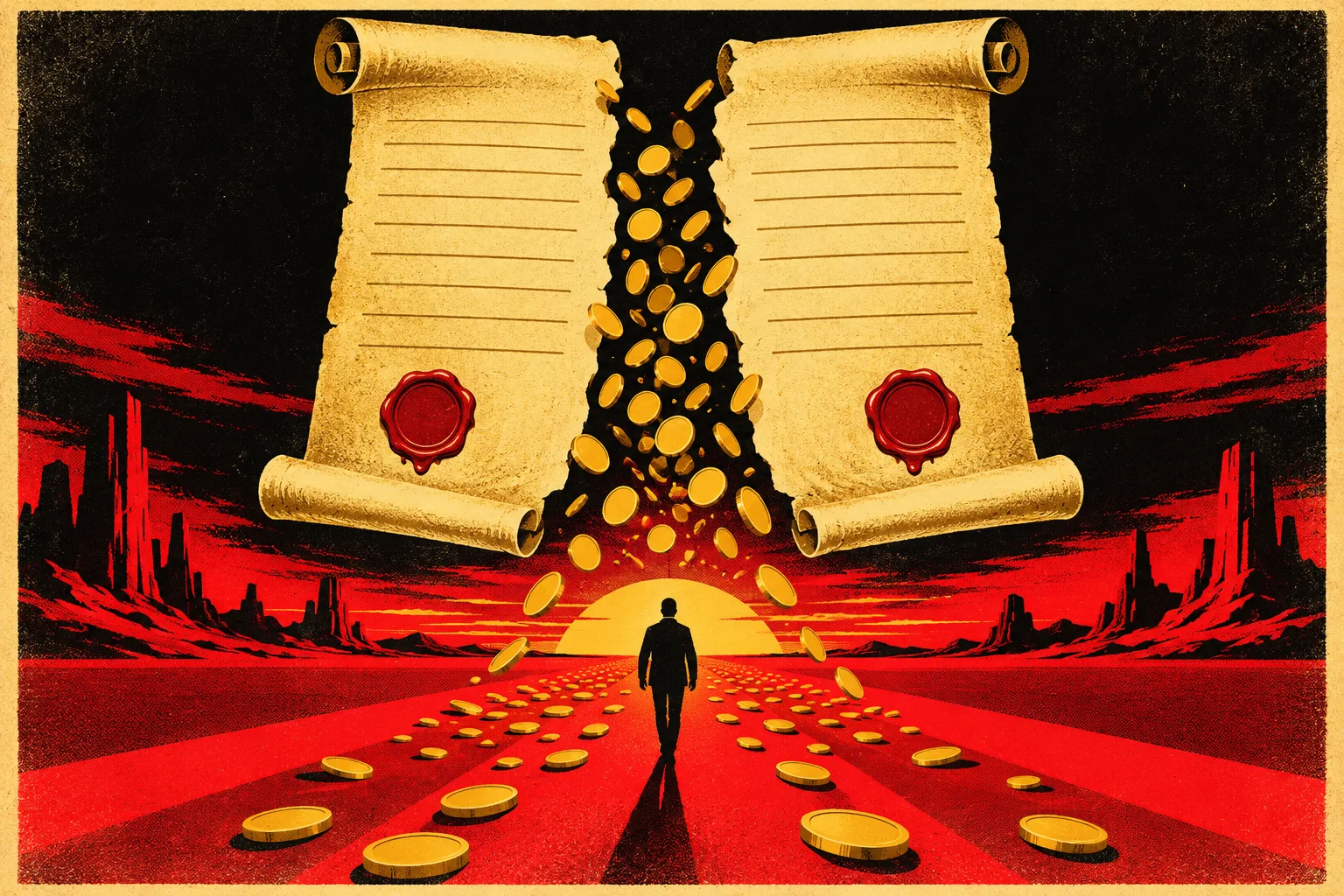
Ehrman's case runs in two moves. First, care for the stranger as such was absent from Greco-Roman morality: euergetism bought honor, the poor were blamed for being poor, and no philosopher opposed slavery, war, or the domination written into the natural order. Jesus radicalized the Hebrew prophets' concern for the needy with an apocalyptic deadline and redefined the neighbor as the enemy, the Good Samaritan's whole point. Second, the irony: Jesus taught forgiveness, God letting go without a penalty, and atonement is the opposite doctrine, somebody must pay. Paul taught atonement. After Easter, the followers explained the crucifixion by making it a sacrifice, which is the teaching Jesus preached against. Ehrman, no believer, still credits the movement with inventing Western charity: Basil's Basileias and the first hospitals, orphanages, and poor homes. The sovereign twist this blog adds: euergetism conscripted generosity through honor, the state conscripts it through the tax code, and neither produces love. Care for the stranger survives only as something freely given.
Forgiveness Without a Receipt
Markus Maiwald, November 2026
Bart Ehrman has a favorite way to explain the difference between two doctrines that most Christians assume are the same thing, and he borrowed it from somebody else, which he admits. His daughter does something wrong, comes to him, and says she is sorry. He forgives her. He lets it go. That is forgiveness. Atonement is when he says: thanks, dear, I appreciate that. Now, your kitten, I have to kill the kitten, to settle the account. Then we are square.
A God who forgives is not the same thing as a God who requires a payment, and the difference is the subject of Ehrman’s new book, Love Thy Stranger: How the Teachings of Jesus Transformed the Moral Conscience of the West. Ehrman is one of the most widely read New Testament scholars alive, a professor at Chapel Hill, and an agnostic. He is the last man positioned to sell Christianity, which is exactly why his argument lands: the West owes Jesus more than it admits, and organized Christianity buried the core of what Jesus taught, then built its central doctrine out of his execution.
Both halves of that sentence are attacks. The first is aimed at the atheists who want to credit nothing to religion. The second is aimed at the churches. Ehrman caught fire from both directions, and he seems pleased about it.
There Is No Universal Morality
Start where Ehrman starts, by tearing down the comfortable claim. C. S. Lewis argued in Mere Christianity that basic morality is the same everywhere, therefore given from above. Ehrman once believed it. He describes Lewis as, in evangelical circles, the fourth member of the Trinity.
The argument dies on contact with the record. Plato’s Symposium, one of the foundational texts of Western philosophy, celebrates love, and the love it celebrates is pederasty, adult men with boys, treated as an unquestioned good in the greatest mind of the ancient world. Not a universal in sight. And the similarities that do exist across cultures have a simpler explanation than divine gifting: shared DNA. A species survives through cooperation or it gets picked off. Darwin saw it in honeybees; it holds for chimpanzees and for humans. Common moral codes are biology doing its job. They are evidence for evolution, not for a lawgiver.
Which clears the ground for the real question: if morality is not universal, what exactly did Jesus add?
The Poor Were Their Own Fault
The world Jesus walked into had detailed philosophies about how to live well. The Stoics, the Epicureans, and the Cynics all chased what Aristotle called eudaimonia, a satisfied and flourishing life. None of them saw the poor as a claim on anybody.
The ancients took hierarchy for the natural order. The powerful had the moral right to use their power. There was no moral argument against war, none against slavery, none against men ruling women. Domination was not a scandal; it was the weather. The poor sat at the bottom of the same weather system, and giving them money looked like watering rocks: they will just throw it away.
The rich did give, abundantly, and the scholarly name for it is euergetism, a modern coinage for doing good deeds. But look at what it bought. The benefactor funded the buildings, the banquets, the games, sometimes straight into bankruptcy, because holding wealth back made you greedy and small. Public office in an ancient city cost the officeholder a fortune instead of paying one. The honor of the crowd was the return on investment. Where the common people benefited, they benefited as an audience for somebody’s glory. Giving to the needy because they were needy was treated in some of the same moralists as waste, Seneca’s circle included, the same argument you hear today: they will just buy beer and cigarettes. Ehrman grew up in conservative Kansas and reports the line has not changed in two thousand years, except that the ancient world had beer but no cigarettes.
Into this world walked a man who said the poor are not a stage for your honor. They are your neighbors. And he meant more than the man next door.
The Prophets Already Knew
Credit where the book insists on giving it: Jesus invented nothing about concern for the poor. That current runs through the whole Hebrew Bible. Read Isaiah without hunting for verses that predict the messiah, and what you find is a prophet furious that Israel’s elites neglect the needy, announcing judgment for exactly that. Amos says the same. Ezekiel says the same. The God of Israel introduces himself as the one who pulled slaves out of Egypt, and he expects his people to act like it.
Leviticus 19:18, love your neighbor as yourself, comes with context that almost nobody quotes. The neighbor is spelled out: your own people, the Israelite stranger you do not happen to know. And love, in that verse, is not a feeling. It is logistics. If you are hungry, you feed yourself; if you are exposed, you find shelter. Do that for him. Jesus took the verse, agreed with it completely, and then, standing on his apocalyptic clock, made it impossible to respect politely.
No Time for Half Measures
Apocalypticism was everywhere in first-century Judea, a belief that God was about to step into history, crush the powers of evil, and restore paradise, and that everybody had to pick a side before the deadline. The Dead Sea Scrolls showed how mainstream the outlook was. Jesus taught it plainly: some standing here will not taste death before it happens, this generation will not pass away first.
An imminent end to the world explains the radicalism that two thousand years of commentators have tried to sand down. The rich man asks what to do to inherit eternal life. Jesus answers: sell everything, give it to the poor. The man walks away grieving. The disciples are bewildered, because in their economy wealth was the blessing, and Jesus answers that it is easier for a camel to go through the eye of a needle than for a rich man to enter the kingdom.
You have heard the escape hatch: the needle’s eye was a small gate in Jerusalem, camels had to kneel. It is folklore. Medieval commentators invented it, no such gate is attested anywhere, and no archaeology supports it. When the disciples say, then who can be saved, Jesus does not walk it back. He says: with humans it is impossible. And the comfort verse, with God all things are possible, is not a rich man’s exemption. It means God can change your heart until you actually give it away. Then he praises disciples who left homes and families to follow him, in a world where a man was the breadwinner. As Ehrman notes, imagine Peter telling his wife. Nobody packs for that trip unless the end is weeks away.
The same deadline universalized the teaching. If the coming judgment covers the whole world, then God’s concern covers the whole world, and so must yours.
The Neighbor Is Your Enemy
The Good Samaritan is famous, which has blunted it. A lawyer asks: who is my neighbor? Jesus answers with a story in which the hero is a Samaritan, the sworn enemy with the wrong religion from the wrong country, and the point lands as a question: which one was neighbor? The man cannot even say the word. He says: the one who showed mercy.
Love your enemies is in the same key, and Ehrman is precise about what it means. Not warm feelings. Action in their interest. He tells of a Ukrainian theologian, a Christian who escaped the Russian invasion and wrote a book on Bonhoeffer, asked how he can love Russians. His answer: I do not like them and I feel nothing for them. But their best interest is to stop this war, stop killing civilians, and become a people worth living beside. So I want that for them. That is the teaching with the feelings stripped out. It is heavy, and it was meant to be.
The One Teaching and the Bill
Now the center of the case, and the sharpest irony in the history of religion.
Forgiveness, in Ehrman’s definition, is releasing a debt without collecting: no penalty, no payback, the relationship restored as if nothing were owed. Kitten alive, account closed. The book’s claim is that Jesus taught forgiveness on both floors, human and divine: turn back to God, repent, and God simply forgives. No sacrifice required.
Atonement is the opposite architecture: the scales must be balanced, somebody must pay. And the man who taught the first doctrine was executed, in Ehrman’s reconstruction, because the second is what the temple stood for: the sacrificial machine, the revenue of atonement, forgiveness as a thing you purchase through blood at an authorized location. Teaching that God forgives for free, outside the system, is not a harmless opinion in that setting.
Then came Easter. The followers, convinced they had seen the risen Jesus, faced a question with no comfortable answer: if he was the chosen one, why did God let him be publicly tortured to death? Their answer became the architecture of Christianity: it must have been a sacrifice for sins. He died to pay. Within that logic, God does not simply forgive at all; the invoice was issued and settled, by the teacher himself, retroactively.
Sit with that for a second. The movement concluded that God requires payment, and made the preacher of payment-free forgiveness into the payment. Christianity, Ehrman argues, is organized around a doctrine its founder taught against. Paul is the clean evidence: atonement runs through his letters, and repentance, the hinge of Jesus’s own call, is nearly absent from them. Paul has God settling accounts through Christ’s blood, not waving sins away.
Ehrman reports the fallout of writing this: atheists tell him he credits Jesus too much, traditionalists tell him he cannot possibly mean that the church teaches against Jesus. Both objections can be true. That is usually the shape of an irony worth keeping.
Intramural, Then Universal
The movement also trimmed the teaching at the edges, for honest reasons. Jesus’s care had no fence around it. Paul’s communities, small and broke, prioritized their own: help the believer first, because resources are finite and the freeze-out is real. Across the New Testament outside the Gospels, charity turns inward, a community maintenance program. Read first Corinthians 13 at a wedding sometime and notice it is not about marriage; it is about a congregation coordinating spiritual gifts without tearing itself apart. Love as organizational glue, the body metaphor said out loud.
And the incentive problem never fully resolved, in either man. Paul frames love as the health of the community. Jesus, the book notes without embarrassment, promises treasure in heaven: deferred gratification, an investment vehicle with a moral ticker. Ehrman’s position is refreshingly unsentimental: incentivize it however you like, if the hungry get fed, the arithmetic works.
Then the fence fell, by conquest. In 312 Constantine converted; he made Christianity legal and himself its patron, not the state religion. By the end of the fourth century about half the empire was Christian, and the intramural program had nobody outside anymore. When everyone is in the community, care for the community is care for everybody.
Long before the victory, the reputation had already flipped. The apologists of the second and third centuries answered slanders of cannibalism and incest, the standard mud thrown at any enemy of the era, by pointing at the one thing nobody could deny: these people love each other, and not only each other. Love your enemies, Athenagoras and his colleagues argued, look at how we live. Even their enemies’ Gods could not claim that.
The admission came from the enemy’s side, in writing. Julian, the last pagan emperor, Constantine’s nephew, tried to roll the empire back and found he could not, because of the poor. His letter to the high priest of Arsacius survives: it is a disgrace that the impious Galileans support not only their own poor but ours as well, that no Jew ever has to beg, and that our people lack assistance from us. His instruction: build pagan hospitals and charity, out-compete them. The pagans had noticed exactly what Ehrman noticed, and tried to copy the product.
The Man Who Sold Everything
The copy needed a template, and the template has a name: Basil of Caesarea, fourth-century bishop of Caesarea in Cappadocia, born rich. He is one of the few people in the record who did the thing from the parable: sold his possessions, gave to the poor, and meant it. He joined the monastic movement, then founded communities of his own.
Around 369, in the middle of a famine, he built on the outskirts of Caesarea what contemporaries called a new city, the Basileias: housing for the poor, strangers, and travelers, care for the sick, and at its heart a ward for lepers, the untouchables of the age, whose disease left them to starve outside every town gate. The Basileias gave them rooms, beds, food, and medical staff. Institutions of that kind spread from it across the Christian world: hospitals, orphanages, homes for the poor and the old, the institutional skeleton of Western charity. Historians debate how modern a hospital the Basileias really was; Andrew Crislip and others rightly warn against anachronism, and Timothy Miller’s case for the Byzantine hospital as a Christian invention remains contested in the details. What is not contested: nothing like it existed in the Greek or Roman world before, and everything like it after descends from that family of foundations.
The empire’s new religion carried the ethic with it, century after century, until helping the needy became common sense in the West, for Christians, atheists, agnostics, Jews, and Muslims alike. That is Ehrman’s actual thesis. Not that Christianity was good. That this one teaching conquered, and everyone now lives downstream of it.
An Atheist Says Thank You
Ehrman refuses to hand-wave the other ledger, and lists it in full: hatred of Jews leading through pogroms to the Holocaust, crusades, the Inquisition, slavery defended from pulpits, women oppressed by doctrine, centuries of it, done by the church of the man from Nazareth. None of it softens. The claim is only that the same movement built the institutions where strangers get cared for, and that millions of lives exist because of them.
An agnostic thanking Jesus for the moral conscience of the West is the sentence nobody on any side wants said out loud. That is what makes it honest. And his sharpest warning is for the present: people in power weaponizing that inherited compassion for agendas it was never taught to serve, using the name to harm the people the name was spoken for. As Ehrman puts it, that just is not right.
The Samaritan’s Purse
This blog reads everything through one question, and the case of the stranger-love teaching passes it with a wrinkle worth staring at.
The teaching conquered the ancient world because it was voluntary. Nobody was taxed into the Basileias. Basil sold his own fortune, not somebody else’s income. The Samaritan paid from his own purse, on his own detour, and the story never once suggests the innkeeper should have billed the state. Euergetism, the honor economy, was the old conscription of generosity: give, or be shamed. The modern state runs the same machine with a new lever: give through the tax code, under the label of compassion, and call the result love. Both produce transfers. Neither produces a Samaritan, because the Samaritan is precisely the man nobody could compel.
The voluntaryists among us already know how this works; this docket has prosecuted the borrowed adjective before. A budget line that funds strangers is not the same thing as loving them, and the difference is not trimmings. The whole moral weight of the teaching rests on the giving being yours: chosen, uncoerced, yours to refuse and yours to do anyway. Legislate it and you keep the transfer while orphaning the love, which was the only thing the teaching was about.
Ehrman’s conclusion belongs to everyone, and he earned it as an outsider: care for the stranger because they are human is one of the best ideas the species has had, and it came to us through a specific man, an apocalyptic carpenter’s son who told the rich to give it all away and told everyone that God was not keeping score. The institutions are real. The thank-you is due.
What we do with it is the voluntary part. It always was.
Declined or handled with care: the claim that Jesus was crucified specifically for teaching forgiveness outside the temple is Ehrman’s reconstruction and is presented as his; the Gospels themselves give multiple proximate causes and scholars weigh the temple incident, sedition, and apocalyptic fervor differently. The kitten illustration is Ehrman’s borrowing from another source, credited as such. Seneca’s position on indiscriminate almsgiving is summarized from Ehrman’s reading rather than re-verified against the primary text. Exact census figures for fourth-century Christianization do not exist; “about half” is the conventional scholarly estimate.
Read next: Voluntaryism, the Etymological Court case on consent and the state’s borrowed adjective, and The Doorway Doctrine on why voluntary beginnings are what make discipline yours.
Sources
- Library catalog record (2026)
- C. S. Lewis, Mere Christianity, Book 1 (1952)
- Plato, Symposium (c. 385 BC)
- Aristotle, Nicomachean Ethics (c. 340 BC)
- Paul Veyne, Le pain et le cirque (term’s modern vehicle); standard usage in ancient historiography (1976)
- Ehrman’s synthesis in Love Thy Stranger; Seneca’s De Beneficiis discusses misuse of giving (2026 / c. 56 AD)
- Isaiah 1, Amos 2, Ezekiel 22 (c. 8th-6th c. BC)
- Leviticus 19 (c. 6th-5th c. BC (final form))
- Mark 9:1, Mark 13:30 (c. 70 AD)
- Mark 10:17-27 (c. 70 AD)
- P. H. Towner, “The Origin of the Needle’s Eye Gate Myth,” New Testament Studies (traces it to Theophylact or Anselm of Laon) (2021)
- Luke 10:25-37; Ehrman’s reading (c. 85 AD / 2026)
- Ehrman, Love Thy Stranger, central argument (2026)
- Romans 3:24-25, 1 Corinthians 15:3; cf. 2 Corinthians 7:9-10 (c. 50-58 AD)
- 1 Corinthians 12-14 context (c. 54 AD)
- Athenagoras, A Plea for the Christians (c. 177 AD)
- Julian, Letter 22, trans. W. C. Wright, Loeb (c. 362 AD)
- Gregory of Nazianzus, Oration 43 (funeral oration for Basil); Crislip, From Monastery to Hospital (c. 369-372 / 2005)
- Timothy S. Miller, The Birth of the Hospital in the Byzantine Empire; contested in detail by Crislip and Ferngren (multifunction institution, not a modern hospital) (1985 / 2005)
- Edict of Thessalonica, 380; standard imperial history (312-380)
- W. V. Harris, Ancient Literacy (1989)
- Anecdote told in the interview; the theologian’s book not independently checked here (2026)