The Etymological Court #16: Maoism
Peasant revolution against the new elite; it became the new elite.
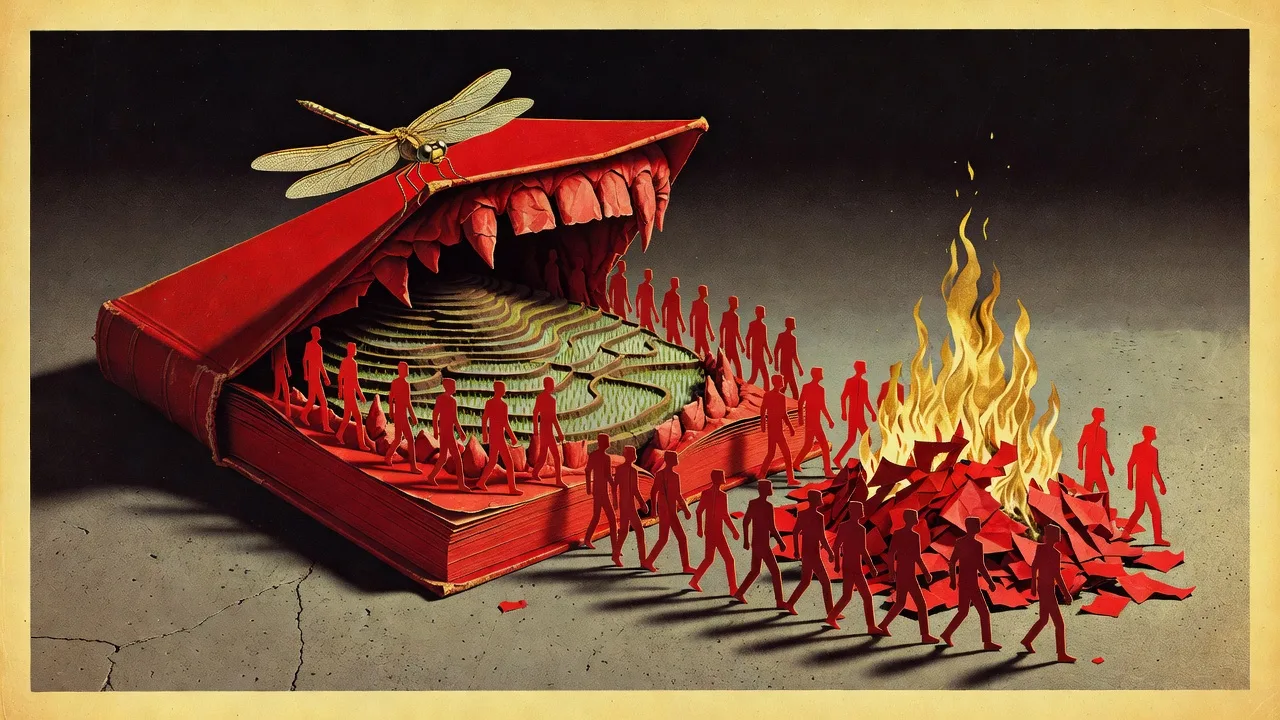
The war against the new elite became the new elite. Hard case: the court is precise, not kind.
The Word
Mao, the surname of one man, born in Hunan in 1893, plus -ism, the suffix of doctrine. Maoism: a doctrine named after a single man. Other doctrines name their theories. This one names its theorist. Confession and verdict in the title.
Communism names its -isms after people: Marxism, Leninism, Stalinism. But a name on a doctrine is a confession: a theory that carries a person’s name is measured by that person’s career. When the man lives long enough to run the experiment himself, the career is the verdict. Marx never had to sign off on Stalin’s purges; Marxism outlived him. Lenin never had to chair a Politburo that enforced his name; he refused it first. Mao got to test his own thought, personally, on hundreds of millions of people. The test is the case. The case is closed.
The word was already a compromise. The Party canonized Mao Zedong Thought at the 7th Party Congress in 1945: Marxism-Leninism adapted to Chinese conditions, written into the party constitution. “Maoism” is the Western label, arriving in the 1960s with the Sino-Soviet split, when parties worldwide picked Mao’s side against Moscow. Thought or ism, the move is the same: a theory reduced to one man, and one man’s career, with all its bodies.
What It Was For
This is a hard case. The court reads no charity into the word. It reads the claims accurately, and then measures them against practice. Where the first school had real insight, the court credits it. Where the practice ate the insight alive, the court records the meal.
1. Marxism for peasants. Marx wrote the revolution for the industrial proletariat. China was a sea of peasants; the factory worker was a sliver. The first school’s answer: the countryside surrounds the cities, and the peasant is the revolutionary class. The diagnosis was correct and not just for China; the entire twentieth century’s agrarian revolutions proved Marx’s industrial focus a European provincialism. The court credits the question.
2. Protracted people’s war. Rural insurgency, guerrilla war from the countryside, trading space for time until the enemy drowns in the interior. A serious strategic insight, demonstrated in the field by the people who wrote it.
3. The mass line. From the masses, to the masses. Cadres gather the scattered wisdom of ordinary people and return it as policy. Knowledge begins in practice. A genuine epistemology, and one the bourgeois academy is still catching up to.
4. Anti-bureaucracy, continuous revolution. The fear that the revolution would harden into a new ruling class, and the claim that class struggle continues even after power is seized, so the new elite, the “capitalist roaders,” must be overthrown again and again by mass action. The fear was real. The remedy was the murder.
The diagnosis was real. The remedy was the murder. The court credits the question and charges the man.
Why It Mattered
Two failures of orthodox Marxism created the opening. The first: peasants were invisible. Marx’s proletariat was the factory, and the Comintern kept ordering urban insurrections in a country of villages. The Kuomintang drowned them in blood, the Shanghai massacres of 1927 chief among them, the worker leaderships of the city parties machine-gunned in their beds. A Marxism that cannot see peasants is dead weight in a peasant country; that observation is not anti-Marxist, it is post-Marxist in the only honest sense.
The second: the bureaucracy. Even a successful revolution builds a state, and a state builds officials, and officials build a distance between ruler and ruled that compounds faster than any slogan can close. Mao named the danger a new class. A revolution that installs a new elite is a lie wearing a flag. The first school saw both failures. Precision requires saying so: the questions were real, and the asking was the work. The answer was the Great Leap and the Red Guard. The court credits the diagnosis and charges the prescription.
The First School
Yan’an. The Long March. The theory.
The Long March of 1934: the encircled base in Jiangxi, eighty-six thousand who set out, a remnant of a few thousand who arrived in the caves of Yan’an. The survivors did not come to build a bureaucracy. They had lived the mass line, or died failing it.
In Yan’an the doctrine was written: On Contradiction, On Practice, On Protracted War, On Guerrilla Warfare. The strategy was precise: strategic retreat, stalemate, counteroffensive; the enemy’s strength dissolves in the countryside like ink in water. The politics were precise too: serve the people, the party as spearhead, not master. The mass line had a hidden premise, though, and the premise was a fuse. Someone must hear the masses. One man hears them. One man decides what they said. One man reads the report from the countryside and decides what it means. The doctrine that started with the peasant ended with the helmsman.
What Happened
The practice. The blood, honestly counted, because counting is what this court does.
The Great Leap Forward, 1958-1962. Steel from backyard furnaces, collectivized communes, grain quotas that confiscated the seed corn. The largest famine in history, manufactured in peacetime by policy. Scholarly estimates of excess deaths run from the low twenties to more than fifty million; the honest number is tens of millions, and the word “excess” is obscene when the cause was a state. Cadres who reported the truth were purged; cadres who reported the fantasy were promoted. The system’s information network was the first thing it destroyed: the very mechanism that could have warned of the famine was the mechanism the doctrine told them to suppress. Tens of millions of peasants, in a country of peasants, starved to death to prove that peasants didn’t matter as much as the doctrine about them.
The Cultural Revolution, 1966-1976. Continuous revolution made flesh. Schoolchildren were armed with the thought of the Chairman and sent to smash the old world: professors, doctors, artists, librarians, monks, temples, books, officials, neighbors, parents. Hundreds of thousands dead by torture, suicide, and execution; millions more destroyed in careers and bodies and the slow violence of ruined families. When the Red Guards became inconvenient, they were sent down to the countryside to learn from the peasants they had been told to liberate. The anti-bureaucratic revolution produced the most centralized state in Chinese history, and its own leader graded the result at seven parts success and three parts failure. It was the failure that ate the country.
The usurpers. The PRC state: after Mao died, the party built a capitalist economy while keeping its own monopoly. State capitalism with Mao as logo, his face on the hundred-yuan note, the revolution’s corpse embalmed and put in circulation as currency. And the Western campus Maoists, who wore the Little Red Book as a talisman and chanted for the Red Guards from campuses in countries with open borders and a free press: fashion, at full discount. The cost was paid entirely by Chinese peasants who never made the curriculum. Fashion never has to face its own consequences; that is the privilege of the lecture hall.
The Verdict
Maoism = Marxism adapted to peasant revolution: protracted people’s war, the mass line, continuous revolution against the new elite. Its own practice (the Great Leap, the Cultural Revolution, tens of millions dead) became exactly the thing it claimed to fight. The first school loses its own case. The court is precise, not kind.
The rule of this court is first school wins. Here the first school needed no usurper; it devoured itself, publicly, at industrial scale, with body counts that ended in eight figures. The doctrine that claimed the peasant as its subject made the peasant pay for the doctrine with his harvest, his family, his life. The doctrine that named the new class became the new class’s founding myth. A word named after a single man is not an analysis; it is a logo, and logos are for loyalty, not for truth.
The Door
Can they leave?
No. And the regime built the border to prove it.
Under Maoism, exit was the ultimate betrayal. Emigration was defection, an application to leave a confession that the revolution had failed. The border was a crime scene: watchtowers, electrified fences, a river where the escaping drowned or were shot. The doctrine that claimed to liberate the peasant could not survive a single peasant walking away from it. The wall was the confession.
That is the whole case in one image. A revolution whose members cannot leave is not a liberation; it is a holding pen with a slogan. Every -ism in this docket faces one question that outranks all the others: can they leave? The first school of Maoism answers with walls. The door is the test, and the test is failed at the fence.
Series: The Etymological Court · Previous: Marxism-Leninism · Next: Monarchism