The Etymological Court #15: Marxism-Leninism
A doctrine Lenin disowned before he died, canonized after it, by the man he asked to be removed.
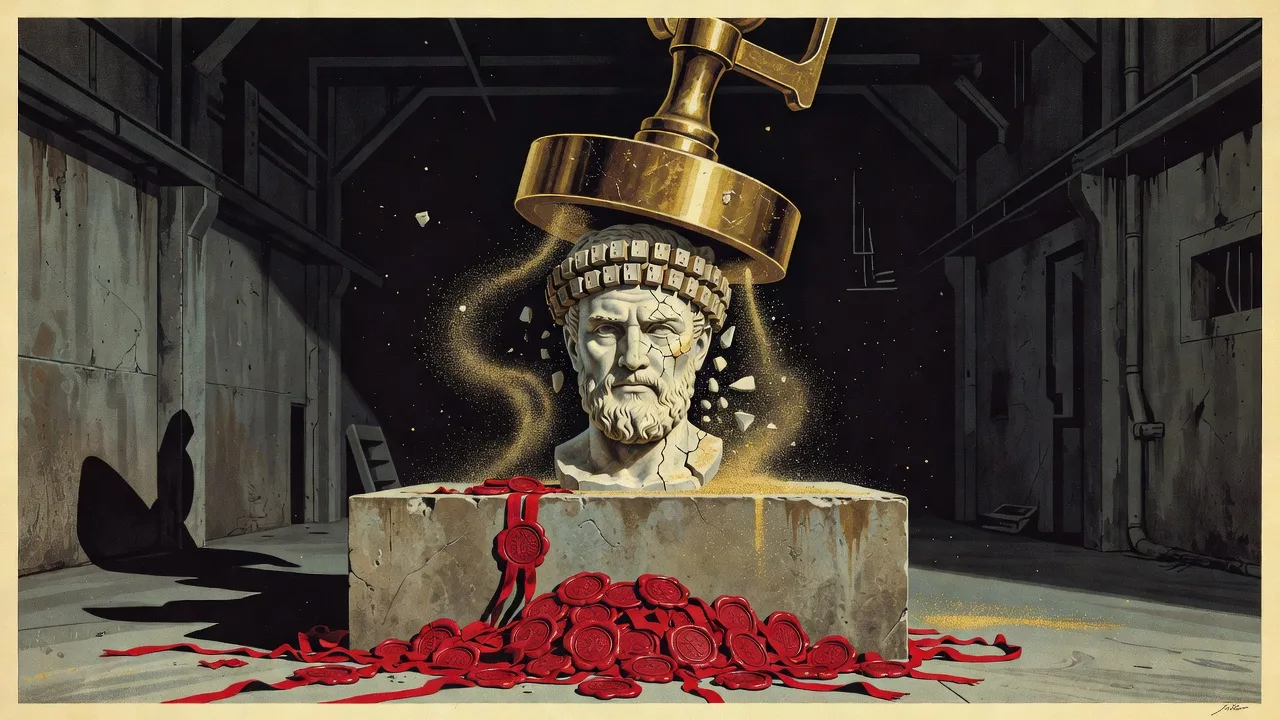
A doctrine is a forgery when the man it is named for refused the name before he died.
The Word
The etymology here is the entire case. Usually this court asks who stole a word from its first school. This time the word was never anyone’s to steal; it was minted after the man it claims was dead. There is no first school, only a tomb with a label glued on.
Lenin died in January 1924. “Leninism” as a doctrine, a named school with a canonical definition, appears in print months later, in April 1924, in Stalin’s lectures at the Sverdlov University, published as Foundations of Leninism. The definition Stalin gave it: “Marxism of the era of imperialism and of the proletarian revolution.” A school, canonized, with a founder who could no longer object. The original sin is the publication date.
But the founder had objected. In 1917, on record, Lenin said: “I am not a Leninist.” It was his way of refusing the cult before the cult existed. Stalin built a doctrine on his name anyway. The dodge is the confession: a man who is not allowed to disavow the -ism named after him has stopped being a doctrine and has become a tombstone.
A name no one wearing it ever chose. No one joins “Marxism-Leninism” the way one joins a movement. You were born into it, inducted into it, or shot for refusing it. It is a uniform, not a school.
What It Was For
Not what it wanted, what it was for. This court is in the business of measuring a doctrine by what it did, not what its pamphlets promised. Marxism-Leninism was built for one function: legitimation. Its job was to make one-party rule look like science, and one man’s succession look like theology.
The parts. The vanguard party: a small, disciplined, professional elite that “leads” the working class because the working class is too confused to lead itself. Democratic centralism: free discussion of policy until the decision is made, then absolute unity in executing it. Note the asymmetry, because the asymmetry is the whole design. The democracy is a pre-decision courtesy. The centralism is a post-decision commandment. In the party that ran the USSR, that discussion had a habit of ending in exile or a bullet; so in practice, centralism. Always centralism.
And the deepest trick, the one that closes the trap: the party is not the instrument of the class; the party is the class’s consciousness. Question the party and you are not disagreeing with a government; you are disagreeing with your own class, your own history, your own future. The theology holds the door shut from the inside, with the prisoner’s own hands.
Why It Mattered
Because it solved a problem that had to be solved or the enterprise collapsed: Marx’s prediction had failed, and the failure needed a patch.
Marx said the workers would rise, the state would wither away, and the commune would replace the bureaucracy. Instead, the revolution happened in the most backward country in Europe, and the state did not wither; it grew teeth, and the teeth had names. Here the doctrine performed its masterpiece. If the revolution failed, Marxism was wrong. Unless the workers were not ready; they needed guidance, a vanguard, the party. And if the party had to be unassailable, the party’s rule had to be theology. Marxism-Leninism was the patch that kept the machine running after the prophecy died. One-party bureaucracy was reclassified: not a failure of socialism, but its highest form. The faithful were invited to admire the surgery that amputated their own claim.
The First School
The rule is first school wins, and this case is perverse, because the first school is the school that refused the label. The honest first school here is the school the -ism was attached to, not the school that attached itself.
Marx, at his most precise, described the state as a parasitic body on society: an excrescence to be abolished, not a body to be exalted. His entire critique was aimed at the class that uses the state to rule over everyone else. Read the Critique of the Gotha Programme, the Civil War in France, the letters to the Russian populists; the verdict is consistent. Stalin built a doctrine that made that parasite the god of a new church, and the new church’s first miracle was to disappear the corpse of the man who wrote the scripture.
Lenin was a wartime improvisation, and the court records it as such. The vanguard party was Lenin’s answer to a specific emergency: an underground organization in a police state. The party had to be secret, centralized, disciplined because the Tsarist Okhrana would destroy anything loose. It was a tactic born of illegality, not a law of history. And he said it himself, in 1917: “I am not a Leninist.” And in his final letters, the Testament, he asked for Stalin to be removed from his post as General Secretary, on grounds of rudeness, disloyalty, and a tendency to concentrate power. The Testament was suppressed; the man it indicted became the canon. Read both facts together. The doctrine and the deposition are the same document.
Stalin took the improvisation and made it eternal. The emergency measure became the permanent structure. And the dead man’s refusal was overruled posthumously, by the man Lenin had asked to be removed.
What Happened
Stalin canonized it. Marxism-Leninism became the official state ideology of the USSR: taught in every school, enforced in every university, codified in every party organ, deployed to justify collectivization, the purges, the gulags, and the worship of the leader who wrote the definition. The structure had a self-sealing quality: the doctrine that declared itself science required the scientist-in-chief to enforce it. Dissent became a crime against reality.
Every communist state adopted the compound as official religion. Every party-state that needed a theology grabbed the same brand, Marxism-Leninism, and its national variants: Mao Zedong Thought, Juche, the rest of the family. You did not have to believe it; you only had to be caught disbelieving it. Apostasy was a firing-squad offense, and the firing squad did not need a quorum.
And it became the brand of state capitalism. Not the stateless, classless, moneyless society Marx described, but a state that owned everything, a class that ruled everything, and money that kept mattering. This court ruled on “communism” last week; the same finding applies here with compound interest. What existed was state capitalism, and Marxism-Leninism was the label that persuaded the worker that the state-owner was his friend, his conscience, and his father at once. The family resemblance to theology is not a metaphor.
The Verdict
Marxism-Leninism = a state ideology invented after Lenin’s death to canonize one-party bureaucratic rule. The word is a posthumous forgery. First school wins, and the first school is a man who said, on record, “I am not a Leninist.”
The court honors Lenin by quoting him. The doctrine named after him is the doctrine he refused, canonized by the man he asked to be removed, in the language of science and the practice of the inquisition.
The Door
Can they leave?
The state that cannot be exited. In the USSR, exit was not a right; it was the capital crime of treason. A border crossing was a defection, a visa application was a confession, a refusal to return was a death sentence in absentia. The map ended where the country ended.
The party that cannot be quit. Resigning from the Party was not resignation; it was apostasy: at best a broken career, at worst a bullet. In a one-party state the party is the ladder to everything: the job, the flat, the ration, the permission to exist. To quit the party was to resign from your own life.
And democratic centralism is a door that opens inward. Discussion is the welcome mat: debate, input, “free discussion” before the decision. Then the decision lands and the door slams: unity of action, obedience, and the discussion you thought you were having is retroactively reclassified as a crime. You were free to walk in. You were never free to walk out.
This court hands every -ism the same test, and it hands Marxism-Leninism the full sentence: if the people inside cannot leave with their lives and their reputation intact, it is not an association; it is a door that opens inward, and the people inside are not members, they are inventory. The exit right was not forgotten; it was the first thing eliminated, because a state that can be exited is a state that can be held accountable. No doctrine that locks the door may claim the name of the man who told his own followers to refuse him.
Series: The Etymological Court · Previous: Communism · Next: Maoism