The Etymological Court #9: Nationalism
A people's right to be itself, not the state's license to rule over others.
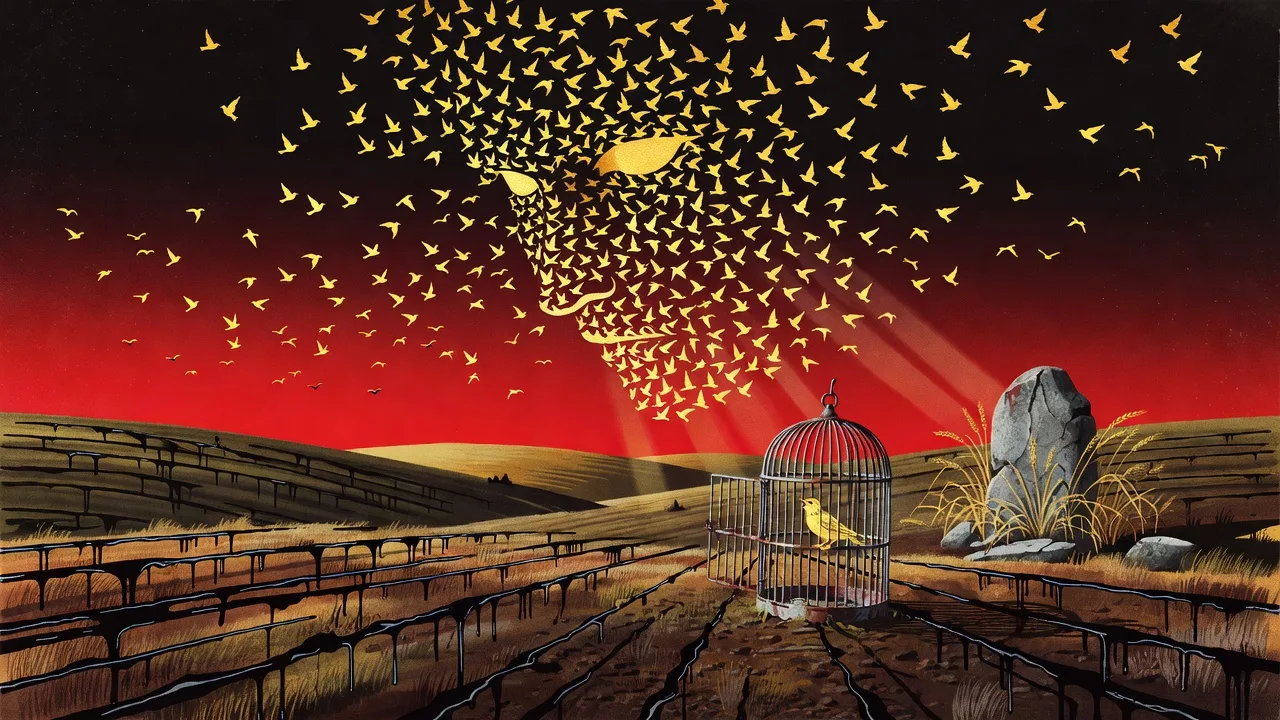
The word began as a people’s right to be itself. It ended as the state’s right to make everyone else bleed for it.
The Word
natio. Latin for birth, from nasci, to be born. A natio was a group bound by birth: a breed, a clan, a people. For most of its life the word named what you were born into, not what you fought for.
The word became political in the 1790s, in the same storm that produced nationalisme in France (1798) and Nationalismus in Germany. That turn is the whole history: a word for birth became a word for belonging, then a word for movement. And at the center of that movement stood a German pastor and philosopher, Johann Gottfried Herder, writing in the 1770s and 80s.
The word, before the theft, meant one thing: a people has a right to be itself.
What It Wanted
Charity first. Read at its best, nationalism is not a war cry; it is a plea. Every empire in history has told the conquered that they are not a people, only a province; that their language is a dialect, their memory a superstition, their name an administrative detail. Nationalism answered: no. We are not your dialect. We are a people, and we will govern ourselves.
Four convictions carried the first school:
1. A people is real. Not a tax district, not a border drawn by a treaty, but a community of language, memory, and song: a Volk.
2. Language is the soul of a people. Herder’s insistence, the heart of the doctrine: a people’s language is where its world lives. Lose the language and you lose the people, one generation at a time.
3. Self-determination. A people that can speak its own tongue should be able to govern its own house, not to rule others, but to stop being ruled.
4. Equality among peoples. Herder’s nationalism was pluralist: every Volk has its own center of happiness, and none may impose itself on another. The first school was anti-imperial by construction.
Honest people chose this because they had felt the alternative: being told your ancestors were noise.
Why It Mattered
Because empire had produced a new species of crime, erasure. The eighteenth century was the century of the great powers swallowing the small. The partition of Poland. The Habsburgs administering a dozen tongues from one German-speaking court. The schoolroom punishing a child for speaking his own language. Empire did not always kill people; it killed peoples, renamed their provinces, made their languages peasant embarrassments.
And there was a second enemy: the cosmopolitan contempt that looked at a small nation and saw a futureless curiosity; progress marched through the great powers, and the little nations were told to assimilate or die politely. Herder answered both at once. Against the empire, a people’s right to exist. Against the cosmopolitan sneer, the claim that the small was not the past but the precious.
The First School
Johann Gottfried Herder; Riga, then Weimar, the 1770s and 80s. A pastor and philosopher who collected folk songs, and understood before almost anyone that a people’s songs are a people’s constitution.
For Herder, each Volk was a distinct language-and-culture community: a way of being human that no other can supply. And because each is unique, each has the right to develop itself, in its own idiom, at its own pace. He was not an imperialist dreaming of German glory; he was a pluralist who insisted that the variety of peoples is the variety of the human, and that forcing one Volk to become another is a crime against both.
From this root grew the nineteenth century’s liberation movements: the Greeks against the Ottomans, the Italians against the Austrians, the Poles, the Czechs, the Hungarians. Nationalism in its first school was the slave’s argument: we are a people, therefore we are free. The doctrine was precise: a people’s right to cultural self-determination, to speak its language, sing its songs, and govern itself. Anti-imperial, liberatory, egalitarian among peoples.
What Happened
The word flipped, and the flip is the whole case.
What had been the slave’s argument became the master’s. The nationalism of flags, conquest, and blood arrived in the nineteenth and twentieth centuries: the state that conscripts its citizens and sends them to die on the strength of a border; the chauvinist who makes “my nation” a moral adjective and every other nation a footnote. “My nation above all others” is not the first school’s nationalism. It is its corpse, dressed in its clothes, holding a flag.
The mechanism of the theft was simple and familiar: keep the emotional payload, replace the referent. The first school said we are a people, therefore we are free. The usurpers said we are a people, therefore we are owed. The first school opened doors for the small. The usurpers closed them, first on the stranger, then on the neighbor, then on the citizen who disagreed. The liberation movements of the 1840s became the chauvinisms of 1914, which became the fascisms of the 1930s: each step borrowing the old word’s glory to fund the new cruelty.
The court notes the final irony: the supremacist is not a nationalist at all. He is an imperialist wearing a nation’s name. He wants exactly what the first school fought against.
The Verdict
Nationalism = a people’s right to cultural self-determination, to speak its language, keep its memory, and govern itself. Supremacy is its opposite, wearing its name. First school wins.
The Door
Can they leave?
The exit-right test, applied to a nation. A nation you can leave, with your identity intact, is a home. You can love it, work in it, sing its songs, and still walk out the door with your reputation whole, and the nation must respect the departure. That is the nationalism of the first school: belonging that is offered, not imposed; an identity you carry, not a cage you are locked in.
A nation that punishes departure is not a nation. It is a prison with a flag.
Here is the line the court draws. The first school’s nationalism asked only to be allowed to be itself, and the proof it was honest is that it let its members go. The usurper’s nationalism cannot survive the door test, because it is not about the people at all; it is about the state, and a state that cannot be left is a state that must be lied to.
A people’s right to be itself, granted to all peoples equally, costs nothing and imprisons no one. The first school asked for exactly that. It is the only nationalism with an open door, and the only one this court will honor with the word.
Series: The Etymological Court · Previous: Social Democracy · Next: Anarchism