The Etymological Court #8: Social Democracy
Socialism through the ballot box, not the administration of capitalism with a human face.
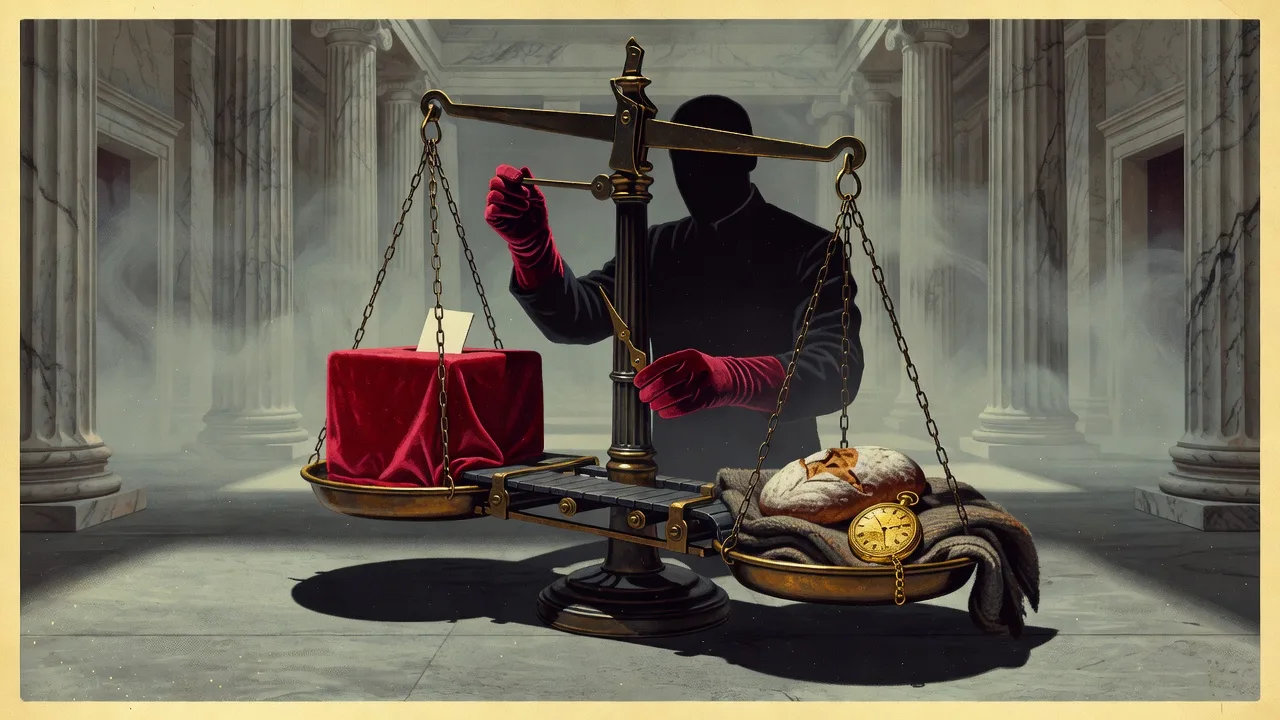
The word meant socialism through the ballot box. It became the administration of capitalism with a human face.
The Word
socius. Latin for companion. demos. Greek for the people, with kratos, rule, attached. The Germans compounded them, Sozialdemokratie, and the compound did what neither root had done alone: it took democracy out of the assembly and aimed it at the factory.
Not “social” as in social programs, but “social” as in the social question: the working class. Democracy extended from the ballot box to the workshop, from the state to the economy.
The term was minted in Germany in the 1860s, on the lips of the Marxist wing entering parliament; Lassalle’s paper, Der Social-Demokrat, predated the party. The name, before the theft, meant one thing: socialism achieved through democratic politics, the working class legislating its own emancipation.
What It Wanted
Charity first. Read at its best, social democracy is the boldest bet in the history of the left: that the working class could win its freedom without a civil war. The ballot box is a lever, not a truce.
What did it want? The workers taking hold of the state the way capital held the factory, and using it, as a class, to write the laws that would dismantle the wage relation. Democracy as the road to worker power, not the cooling room where it goes to expire.
Honest people chose it for a practical reason: the barricades had failed, and the ballot worked, slowly, badly, but it moved. The vote. The eight-hour day. Old-age pensions. Universal education. For the first time in industrial history, workers could point at the state and say: that is ours, we are taking it. The Nordic achievement belongs to this school’s credit: real and durable, won through elections and unions, not insurrection. The court honors it, and insists on the distinction.
Why It Mattered
Because the choice it answered was the poison of the nineteenth century: revolution or resignation. The orthodox Marxists demanded the collapse of capitalism and the seizure of the state, and had no honest account of how that happens without a massacre. The reformists had won the factories’ battles one at a time, and no account of how the victories add up to emancipation.
Social democracy was the third answer. Not waiting for the collapse. Not settling for crumbs. A road: the working class capturing the democratic state to legislate its own freedom. When 1848 burned out in the streets, everyone on the left drew a lesson. The social democrats drew the only one that ended in a party, a parliament, and legislated victories instead of a cemetery.
The First School
Ferdinand Lassalle founded the General German Workers’ Association in Leipzig in 1863, the first mass workers’ party in Germany. His doctrine was the state as instrument: give the working class the ballot, and the state, seized democratically, would legislate the working class into ownership. Universal suffrage, in his system, was the key that turned the lock.
In 1875 Lassalle’s and the Marxists’ factions buried their feud at Gotha and unified under one program. The Gotha Program committed the movement to the democratic road: universal suffrage, free education, state support for producers’ cooperatives, socialism arrived at through the state, not over its ruins. Marx sneered at the wording in his Critique of the Gotha Program; the heirs ignored him and built the largest party in Europe.
Then Bernstein finished the thought. In the 1890s he told the party the truth it had circled for decades: no collapse, no seizure of the barricades. The movement is everything; the goal, whatever it may be, is nothing. Evolutionary socialism: democracy not as the prelude to revolution, but as the revolution itself, stretched over a century of elections.
The doctrine was precise: socialism by ballot. The working class legislating its own emancipation.
What Happened
The word survived. The doctrine did not.
Two world wars, and then the managers took over. What the first school meant as an instrument of class power became, in postwar hands, a program of crisis management: fiscal steering, welfare floors, tripartite bargaining, Keynesian smoothing of the business cycle. The experts administering it on behalf of a working class that no longer owned it. Bad Godesberg is the emblem: in 1959 the German Social Democrats formally renounced Marxism and relaunched as the party of competition wherever possible, planning wherever necessary, socialism as a heritage brand.
The welfare state this produced is real: pensions, healthcare, unemployment insurance, the best the century’s workers got. But watch what the word was made to cover. The first school promised the workers the state. The usurper delivered the state to the workers, packaged as a benefit. One is power; the other is a distribution schedule. The worker who owns the state can change the rules. The worker who receives benefits can only ask for more.
The Third Way finished the job in the nineties: Blair, Schröder, Clinton, social democracy as the competent administration of capitalism. No ownership. No class power. No emancipation. Just management, the word with its first school emptied out of it.
The Verdict
Social democracy = socialism by ballot. The working class capturing the democratic state to legislate its own emancipation. The movement is everything; the goal, whatever it is, is nothing. What exists now is social liberalism: a welfare state managed by bureaucrats, not owned by workers.
The first school wins. If you run a welfare state, you have a fine thing; call it social liberalism, and defend it on its merits. Do not bury “social democracy” in the foundation so nobody asks where the workers went.
The Door
Can they leave?
Test it on the welfare state. The benefit that follows you only if you stay is a lock, not a benefit. The pension you forfeit if you emigrate. The insurance that dies with the job. The “contributions” that become confiscation the moment you try to leave the building. A welfare state you cannot exit is a custodian, not a democracy, and the one vote the first school never thought to count is the vote with your feet.
The first school’s road had an exit in it: workers could vote the state out, strike, organize against it. Worker power you can resign from is worker power. A custodian you cannot resign from is a cage with a benefits brochure.
So here is the test this court hands to every social democrat, and to every -ism in the docket: a system you cannot leave is a distribution schedule with a lock on the door, not a democracy. The Nordic model is the most humane custodian ever built. It is not worker power, and the word, Sozialdemokratie, still means what it meant: the working class, in charge, and free to walk away.
Series: The Etymological Court · Previous: Syndicalism · Next: Nationalism