The Paternalism of the Left: How Marx, Lenin, Marcuse, and Mao Shared One Belief
That you are too stupid to know what is good for you. From Lenin's Was Tun through Mao's Cultural Revolution to Marcuse's liberating tolerance – the left has never trusted the people it claims to liberate. The liberation was always for them.
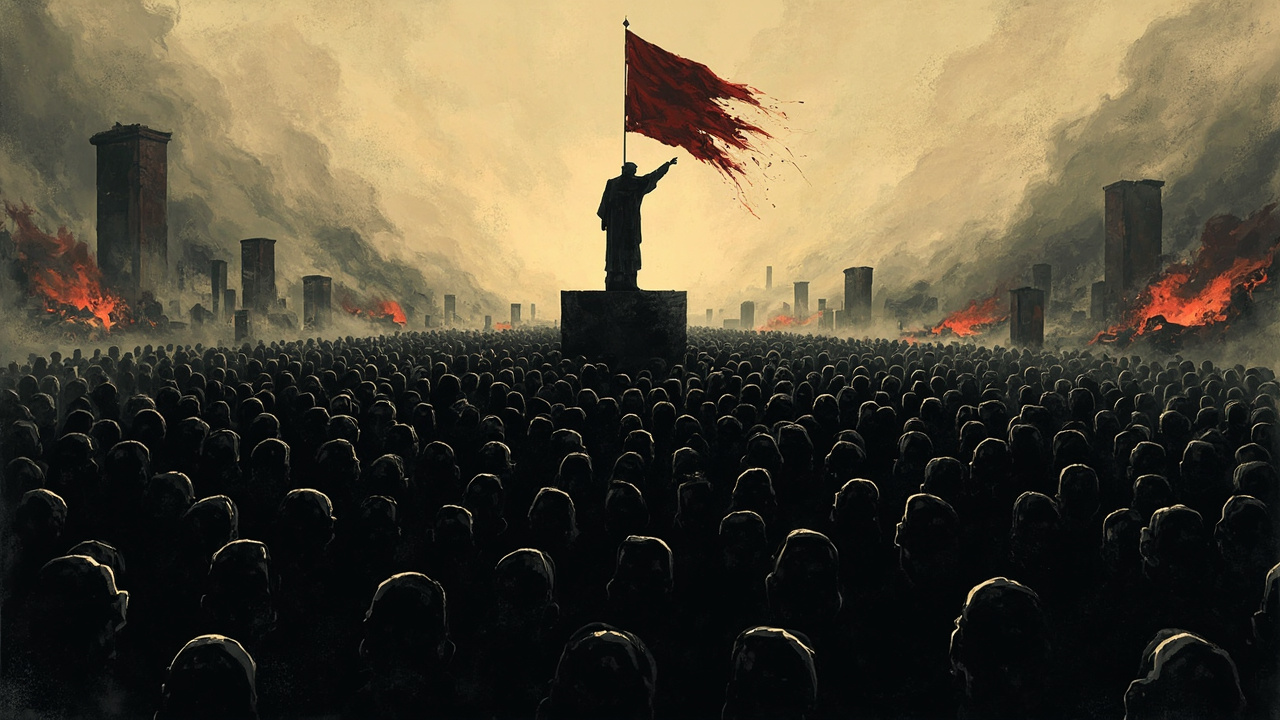
The argument, in brief
The left has always claimed to speak for the people. Across every variant of the tradition – Marx, Lenin, Marcuse, Mao, the Frankfurt School, modern progressivism – there is one conviction that never changes: the masses cannot think for themselves. Their consciousness is contaminated, their desires are false, their preferences are programmed. Lenin's Was Tun in 1902 said it explicitly: either bourgeois ideology or socialist ideology, nothing in between. Mao acted on it: destroy the four olds, re-educate the intellectuals, send the bourgeois to struggle sessions. Marcuse theorized it: liberating tolerance means pre-censorship of wrong thoughts before they enter the mind. The paternalism is not a bug. It is the product. The liberation was always for them, not for you.
„Es gibt keine Mitteldinge … entweder bürgerliche oder sozialistische Ideologie.”
, Wladimir I. Lenin, Was Tun?, 1902
The Speech
A rally in Berlin, 2017. A campus sit-in in Berkeley, 2024. A Labour Party conference in 1998. A Black Bloc occupation of a lecture hall in 2023. The speech is the same.
The people. The workers. The marginalized. The oppressed. The wretched of the earth. The silenced. The voiceless. The left is the champion of the voiceless. The left gives voice to the voiceless. The left is democracy’s truest friend.
The same confidence trick has run for two hundred years, with minor variations in the script.
The left believes the people are too confused, too indoctrinated by the wrong ideas, to speak for themselves or know what is good for them. Left to their own devices, the people would choose the wrong path, embrace the wrong leaders, watch the wrong television, vote for the wrong candidates. That conviction runs from Marx through Lenin, Mao, Marcuse, and the Frankfurt School to the diversity trainer in your HR department. Only the vocabulary changes.
The people cannot think for themselves. They must be guided. They must be re-educated. They must, in extremis, be forced.
The left has never said this out loud in quite this way. It is the conviction underneath every policy the contemporary left proposes. It explains why the left is so comfortable with censorship, with deplatforming, with firing dissidents, with criminalizing wrong speech, with storming lecture halls, with riots to prevent talks from being given, with the slow capture of every institution that forms public opinion.
Paternalism supports the whole structure. Remove it and the structure collapses.
Lenin: 1902
Was tun? Brennende Fragen unserer Bewegung, What Is To Be Done?, Vladimir Ilyich Lenin, 1902. Short and dull, it is also one of the most consequential political pamphlets ever written. Its plain prose codifies the blueprint of every left-wing movement that has existed since.
The question was tactical. The Russian Social Democrats were splintering. The Economist faction thought workers could develop class consciousness on their own, through trade-union struggles. The party should follow the workers. Lenin’s Iskra faction thought this was sentimental nonsense. Workers, on their own, would only develop trade-union consciousness, the desire for better wages and shorter hours. They would never develop revolutionary consciousness. They would never understand the entire system had to be overthrown. That understanding could only come from outside the working class, through intellectuals, the vanguard, and the party.
Lenin won. Here is how he framed it:
„Kann nun von einer selbständigen, von den Arbeitermassen im Verlauf der Bewegung selbst ausgearbeiteten Ideologie keine Rede sein, so kann die Frage nur so stehen: bürgerliche oder sozialistische Ideologie? Ein Mittelding gibt es nicht … jede Herabminderung der sozialistischen Ideologie, jedes Abschwenken von ihr, ist zugleich eine Stärkung der bürgerlichen Ideologie.”
Since the masses themselves, in the course of their movement, cannot develop an independent ideology, the question stands thus: bourgeois ideology or socialist ideology? There is no middle ground … any diminution of socialist ideology, any deviation from it, is simultaneously a strengthening of bourgeois ideology.
Either you think what we tell you, or you strengthen the enemy. Lenin leaves no neutral position, no room for genuine differences within the working class, no question on which reasonable people can disagree. Each side claims the correct view; any position between them is surrender.
A war between two ideologies with no neutral ground leaves no room for democracy or democratic debate. You pick a side or you are treated as a deserter.
The pamphlet was not popular at the time. Georgi Plekhanov, the father of Russian Marxism, called it „eclecticism” and „a strange philosophy.” Rosa Luxemburg, later murdered by the regime Lenin built, wrote that it „shows plainly … how deeply its author is infected with the fanaticism of the circle.” Even inside the socialist movement, Lenin’s view was seen as extreme.
It won. The faction that internalized it, the masses cannot think, intellectuals must lead, the vanguard alone possesses revolutionary consciousness, became the Bolsheviks. They took the name from bolshinstvo, majority. The doctrine was the opposite of majoritarian. The Bolsheviks believed the majority could not be trusted. The majority had to be organized, led, disciplined, and, when necessary, purged.
The pattern was set. A century later, the left still runs on the same code.
Mao: 1966
Lenin wrote the theory. Mao Zedong pulled the trigger.
The Great Proletarian Cultural Revolution, launched in 1966, is usually read as a power struggle between Mao and the party bureaucrats, Liu Shaoqi, and Deng Xiaoping. That reading is correct but incomplete. The Cultural Revolution implemented Lenin’s doctrine that the masses cannot think for themselves and must therefore be re-educated by force.
Mao named four targets, the „four olds”:
- Old thought
- Old culture
- Old customs
- Old habits
Not specific policies. Not specific institutions. The entire texture of pre-communist Chinese civilization. Confucian ethics. Ancestor worship. Family hierarchy. Traditional medicine. Classical literature. Temple architecture. Opera. Cuisine. Calligraphy. Painting. Festival rituals. Wedding customs. Funeral rites. All of it. Any of it could be declared „feudal,” „bourgeois,” „revisionist,” or, the most flexible accusation, „counter-revolutionary.”
Red Guards, students, teenagers, many barely into their teens, were mobilized to attack the four olds. Temples destroyed. Books burned. Paintings slashed. Statues toppled. Intellectuals paraded through the streets in dunce caps, made to kneel on broken glass, beaten, humiliated, killed. Professors sent to „cadre schools”, re-education camps in the countryside, to learn from the peasants how to think correctly. Anyone who protested was sent to a „struggle session”: a public accusation ritual where the accused confessed their bourgeois crimes before a mob whipped into a frenzy of denunciation.
The terror was deliberate and central to the project.
If the masses could think for themselves, no re-education would be necessary. If the workers possessed authentic class consciousness, no struggle sessions would be needed. If old customs and old culture were merely wrong opinions in a marketplace of ideas, the correct response would be debate, persuasion, the slow work of changing minds.
Mao did not believe the masses could change their own minds. He believed they had been indoctrinated by centuries of feudal superstition. Their preferences, including their preferences for the civilization they had actually built, were false preferences, programmed by the exploiting class. The Cultural Revolution was not a debate with the four olds. It was an attempt to extirpate the four olds from the body of the Chinese people, to root out false consciousness at the level of feeling, taste, ritual, family loyalty, aesthetic preference, and unconscious habit.
It failed. The Cultural Revolution is now officially condemned by the Chinese Communist Party itself as a catastrophe that set China back decades. But the failure was tactical, not doctrinal. The doctrine, that the people cannot think for themselves, that their consciousness must be remade from the outside by force, remains the doctrine of the left.
Marcuse: 1965
Herbert Marcuse was born in 1898. He lived through the failures of both Leninism and Maoism. He saw, with his own eyes, the terror the doctrine produced when implemented. He fled Germany in 1933, fled the United States briefly in the early 1940s, returned, watched Stalin’s crimes exposed, watched the Hungarian uprising crushed, watched the Berlin Wall go up.
He kept the doctrine.
The Frankfurt School, of which Marcuse was a founding member, existed to answer one question: why had Marxism not produced the revolution Marx predicted? The classical answer, workers not yet class-conscious enough, capitalism not yet collapsed into crisis, history needed more time, was unsatisfying to a movement that had been waiting since 1848.
The Frankfurt School’s answer was more radical. The problem was not that capitalism had not yet collapsed. The problem was that it could not collapse through the workers alone. The workers had been captured. Their consciousness had been colonized. Their desires had been manufactured. They thought they wanted a car, a television, a stable job, a nice house. They did not understand these were false needs, produced by the capitalist system to integrate them, to make them content, to prevent them from recognizing their chains.
The diagnosis was devastating and had an immediate policy implication: if workers could not develop revolutionary consciousness because their consciousness was already contaminated, it had to be manufactured for them. The critical theorists, academics, party intellectuals, and the Frankfurt School itself would manufacture it. They became the new vanguard, rather than the proletariat: the theorists, the awakened ones with „critical consciousness.”
Marcuse put the doctrine in his 1965 essay Repressive Tolerance as clearly as Lenin had in Was Tun sixty-three years earlier:
„Die Bedingungen, unter denen Toleranz wieder eine befreiende und humanisierende Kraft werden kann, sind erst herzustellen. … Wenn die … Neutralität … dazu dient, die herrschende Intoleranz und Unterdrückung möglichst klein darzustellen oder gar freizusprechen, dann ist diese Art Toleranz unmenschlich.”
The conditions under which tolerance can again become a liberating and humanizing force have still to be created. When such neutrality serves to minimize or even excuse the prevailing intolerance and oppression, then this kind of tolerance is inhuman.
Translation: the people cannot be trusted with the truth. Their preferences for the existing order are manufactured by the existing order. Their tolerance of their own oppression is itself a form of oppression. The „neutral” marketplace of ideas is not neutral, it is the ruling class’s most effective instrument of control.
And therefore: tolerance must be engineered. The right must be silenced. The left must be amplified. And this engineering must extend beyond speech:
„Befreiende Toleranz würde mithin Intoleranz gegenüber Bewegungen von rechts bedeuten und Duldung von Bewegungen von links.”
Liberating tolerance would mean intolerance against movements from the right and toleration of movements from the left.
Popper’s tolerance paradox said you may use intolerance as a Notbremse, an emergency brake, when the intolerant refuse rational debate and turn to violence. Popper set a high bar: the brake was for emergencies, not for routine political disagreement.
Marcuse turned the brake into the accelerator. For Popper, intolerance was an emergency measure. For Marcuse, intolerance was the baseline condition of any just society. Tolerance was what you deployed after the revolution, when the wrong class had been silenced and the right class had inherited the discourse.
The paternalism is explicit: the masses cannot be trusted because their consciousness is contaminated. The critical theorist claims to see through the contamination and therefore claims both the right and the duty to override their preferences in the name of their true interests.
Marcuse never sent anyone to a struggle session. He never burned a temple. He never built a re-education camp. He did not have the power. But he wrote the theology of the struggle session, the temple-burning, the re-education camp. He gave the intellectuals who would later run those institutions the moral confidence to do so. He told them that what they were doing was not violence against people. It was liberation of people from their own false consciousness.
The Thread
The same conviction runs through each stage.
Marx in 1848: the workers, under the spell of bourgeois ideology, do not recognize their own exploitation. The Communist Manifesto is addressed not to the workers but to the communists, the ones who see clearly.
Lenin in 1902: the masses, on their own, will only develop trade-union consciousness. Revolutionary consciousness must be brought to them from outside by the vanguard.
Gramsci in the 1920s and 1930s: cultural hegemony, the ruling class controls the workers not by force but by manufacturing their consent through the institutions of civil society. The war of position must be a long, patient war over the institutions of culture.
The Frankfurt School in the 1940s and 1950s: the culture industry, the family, the unconscious, every domain of human life has been colonized by the ruling ideology. The masses’ preferences are false needs.
Marcuse in 1965: tolerance itself is a weapon of the ruling class. Liberating tolerance means silencing the right and amplifying the left.
Mao in 1966: destroy the four olds. Send the intellectuals to the countryside. Re-educate the masses by force. The Cultural Revolution is the policy.
Across one hundred and eighteen years, these thinkers form a single tradition, despite their internal disagreements. They did not independently happen upon similar conclusions. They shared the conviction that the people cannot think for themselves.
The contemporary heirs of this tradition are not Maoists. Most of them have never read Was Tun or Repressive Tolerance. They do not need to. They have absorbed the conviction through a thousand cultural channels, the university lecture, the diversity training, the editorial page, the social-media feed. They believe, without ever having made the argument, that the people who voted for the wrong candidate are suffering from false consciousness. They believe the books the wrong people want to read should not be published, the speeches the wrong people want to give should not be delivered, the questions the wrong people want to ask should not be entertained. They believe this not because they are evil but because they have inherited, without examination, the conviction that some people, the awakened ones, the critical ones, the ones with the right consciousness, have the right to override the preferences of the many in the name of the many’s true interests.
The paternalism did not die with Lenin. It did not die with Mao. It did not die with the failure of the Cultural Revolution, the collapse of the Soviet Union, or the documented murder of one hundred million people by socialist regimes in the twentieth century.
It adapted. It migrated from Moscow to Cambridge to the editorial offices of every major newspaper. It took new names. It learned new vocabularies. It acquired the manners of a liberal elite.
Same conviction.
Why Your Happiness Offends Them
The contemporary left does not want you to know what this doctrine says about happiness.
Marcuse believed, and wrote, that happiness in a repressive society is itself a form of repression. A worker who is happy with his job, his family, his television, his weekend, a worker who has been successfully integrated into the capitalist system, is a worker who has been successfully neutralized as a revolutionary agent.
„Die Reklame der Selbstverwirklichung fördert die Beseitigung beider. … Selbstverwirklichung … isoliert das Individuum … von seinem politischen Dasein.”
The advertisement of self-realization promotes the elimination of both. Self-realization … isolates the individual from his political existence.
Translation: your attempts to live a good life, your career, your hobbies, your friendships, your family, your projects, are forms of complicity with the system. The more successful your private life, the less revolutionary you become. The more content you are, the more thoroughly you have been integrated. The more comfortable, the more domesticated. The more domesticated, the more useless to the revolution.
This is the deepest layer of the doctrine. It explains the strange, persistent misery of the contemporary left.
The left is constitutionally incapable of letting you be happy with what you have. If you are happy with your job, the left will tell you the job is exploitation. If you are happy with your marriage, the left will tell you the marriage is patriarchy. If you are happy with your body, the left will tell you your body is a construct. If you are happy with your nation, the left will tell you the nation is white supremacy. If you are happy with your civilization, the left will tell you the civilization is irredeemable.
The attack on your happiness follows the doctrine rather than cruelty. It treats happiness as evidence of false consciousness and contentment as proof that the system has integrated you. Your flourishing is the most damning indictment of the revolutionary program.
The doctrine cannot afford for you to be happy. A happy population does not need liberation. A happy population does not need re-education. A happy population does not need critical theorists to tell them what their true interests are. A happy population is, in the precise technical language of the Frankfurt School, repressively desublimated, pacified by pleasures, distracted by comforts, anesthetized by the very prosperity that capitalism provides.
In this doctrine, liberation requires making you unhappy: breaking your contentment, revealing your preferences as programmed, and exposing your satisfaction as false consciousness. You must be made to want the revolution, especially if you were getting along fine without it.
Mao called this „Große Unordnung unter dem Himmel, die Lage ist ausgezeichnet.” Great disorder under heaven, the situation is excellent.
The left has always preferred the disorder to your happiness. Your happiness is the system’s victory. Your misery is the revolutionary’s raw material. Mao was honest about it. The contemporary heirs of the doctrine are still operating on the same logic, with the same consequence. They just no longer say it out loud.
The Difference
Contemporary discourse works hardest to obscure the difference in whom each tradition trusts.
The right, in any defensible tradition of the right, does not believe the people need to be re-educated by force. The right believes the people can think for themselves. The right believes the people have a right to be wrong, to make bad decisions, to embrace foolish beliefs, to vote for idiots, to read bad books, to marry the wrong people, to make messes of their own lives. The freedom to make a mess of your own life is the same freedom that lets you build something good with it.
The right’s faith in the people rests on the conviction that nobody is wise enough to override other people’s choices for their own good: no vanguard, party, critical theorist, or philosopher-king can be trusted with that power. It also rests on the conviction that, throughout recorded history, those who claimed that power have used it to commit atrocities.
The left has never reconciled itself to this. The left has always insisted that some people, the enlightened ones, the critical ones, the awakened ones, do have the wisdom to override other people’s choices. The left has insisted on this for two hundred years. The left has, in power, used this conviction to build the most murderous regimes in human history.
The argument is not between two visions of the good. The argument is between two views of the people who must live under whichever vision wins.
The right says: the people can run their own lives. The proof is that they generally do.
The left says: the people cannot run their own lives. The proof is that we keep trying to do it for them, and the corpses keep piling up.
The pattern is not subtle. A hundred million dead. The Cultural Revolution. The gulag. The re-education camp. The lecture hall stormed by Black Bloc to prevent a speaker from being heard. The editor fired for a wrong opinion. The tenured professor investigated for a wrong reading. The speech coded as violence. The question coded as harm. The book coded as weapon. In every case, the same: some people claiming the right to override other people’s choices, in the name of those other people’s true interests, with the confident certainty that they, and only they, possess the consciousness required to know what those true interests are.
Paternalism connects these cases. It has been the doctrine since day one.
What To Do
For those who refuse to be re-educated:
- Build institutions that cannot be captured by people who claim to know better. Schools. Press. Courts. Markets. The infrastructure of self-governance.
- Defend the right to be wrong. It is the right that makes every other right possible. The moment you surrender the right to be wrong, you have surrendered the right to think.
- Refuse the framing. When the left says „the science is settled,” ask who settled it. When the left says „the experts agree,” ask which experts, funded by whom, dissenting how. When the left says „disinformation,” ask who decides what counts.
- Trust the people you actually know. Not the abstract masses the left theorizes about. The people you have dinner with. The people who fix your car. The people who teach your children. The people you would call in an emergency. They are not in need of re-education. They are doing fine.
- Read the primary sources. Was Tun. Repressive Tolerance. Mao on the Cultural Revolution. Read them in the original, not in the university textbook summary. The university textbook summary is designed to protect you from the texts. The texts are not protected from themselves.
The paternalism will not defeat itself. It has been running for two hundred years. It has killed one hundred million people. It has been refuted in theory and in practice. It is still running. It will be running as long as there are intellectuals who believe they know better than the people they claim to liberate, and as long as there are people willing to be liberated by them.
The liberation was always for them.
Part of the Feminism Series.
Read also: The Walls She Tore Down and The Great Feminization.