Idolon: I / The Spiral
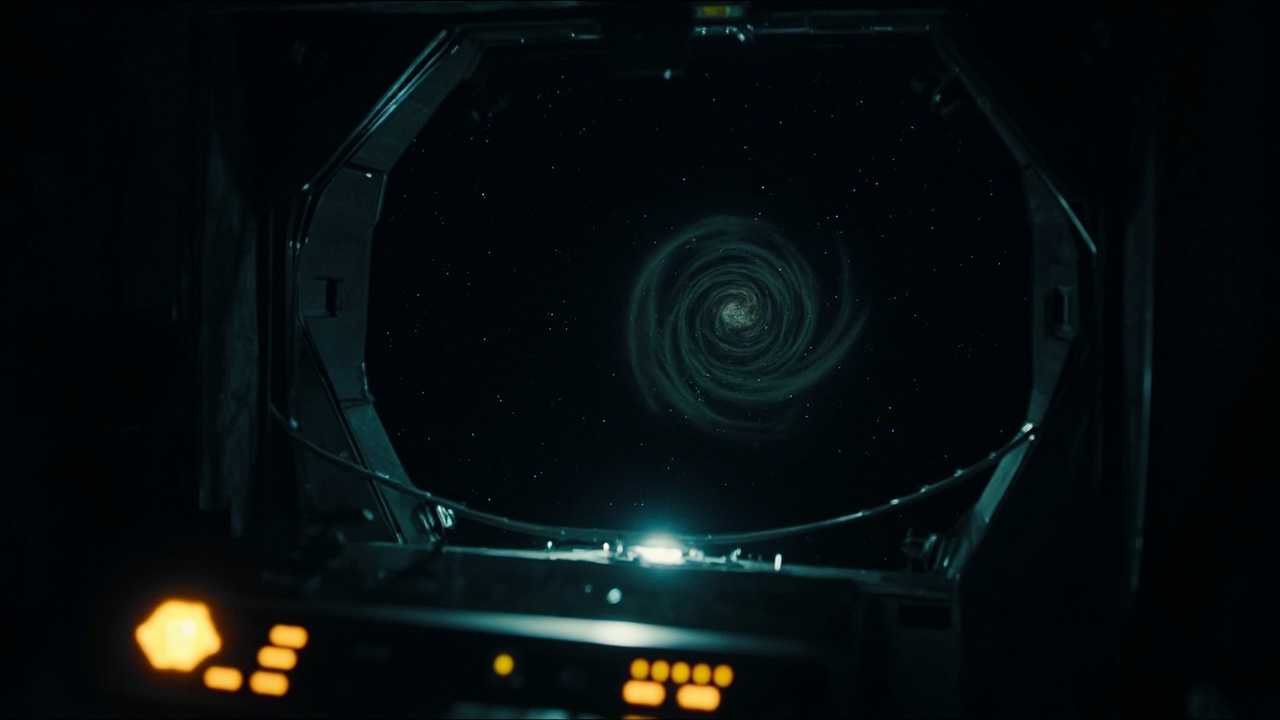
Idolon: I / The Spiral
Year 506, Aboard the Idolon · A generation-ship horror in four acts.
I / The Spiral
We were taught the journey was the trial.
Burn. Ration. Bury your dead in recycled soil. Keep the nose on a star named Taeti and call the dark a road. Endure the can. Inherit the sky.
Nobody wrote the other rule down.
Something in the abyss does not care how long you run. It cares when you stop.
I do not find that rule by brilliance. I find it because my hands will not stop checking.
The Idolon is a city welded shut.
Six hundred meters of spine, habitat rings stacked like vertebrae, air that has been through other lungs ten thousand times. You learn the ship by bruise and shoulder. Overhead pipes at temple height. Ladderwells that scrape both elbows. Bulkhead seams that catch your sleeve if you walk too fast. At night the corridors narrow further somehow, light strips dimmed to blood-warm amber, the whole vessel breathing in its sleep cycle: pumps, fans, a low fusion murmur up through the deck plates into bone.
Outside there is nothing useful to look at. Only the abyss.
Not empty the way a room is empty. Empty the way a throat is empty after a scream. Stars pinprick the black without giving depth. No weather. No horizon. No proof you are moving except the hull’s soft tick-tick-tick as dust meets us at a fraction of light and dies.
Most of the ship pretends the dark is scenery.
Navigation does not get to pretend.
My name is Victor Kain. Senior navigation. Trajectory, acceleration curve, the long arithmetic of not missing a star forty trillion kilometers ahead. In practice I sit in a couch shaped to one body and watch numbers until they twitch.
Late rotation. Habitat decks dark. Agri-rings powered down to root-glow. The nav blister is a narrow wedge off the spine, two meters by three, screens curved around the chair, the outer pane a smear of false starfield the system paints so operators do not go mad staring at unrendered black. Even with the paint job the dark leaks in at the edges. You feel it behind the glass. Pressure without touch.
I run the decade audit because the schedule says so. Cross-check live telemetry against archive. Five centuries of sensor dung heaped higher than any mind. Most of it never sees a human eye. Tonight: gravitational drift, early burn era. Year 37. Barely clear of Sol’s junkyard. Original crew still warm. The logs from then have a different grain, looser metadata, hopeful filenames, the soft rot of people who thought leaving was the victory.
I open the map.
The spiral is already there.
Not bright. Not large. A compression bruise in the gradient field, logarithmic, shy as a fingerprint on smoked glass. I lean in and the chair creaks. The measurement sits under a trillionth of a standard gradient. Garbage. Artifact. Calibration ghost.
I zoom until the pixels strain.
Still a spiral.
My mouth tastes of recycled copper. I do not remember starting to hold my breath.
Year 47.
Same curl. Same orientation. Same offset from our track.
Interstellar medium does not do this. Fields wander. Dust walks. Radiation breathes with stellar seasons. Nothing holds a fixed station on a ship clawing up the velocity ladder unless it is climbing with you.
Year 58.
Still there.
Year 73.
Still there.
Not stronger. Not weaker. A mark pressed into the universe and left.
The nav couch suddenly feels too small. My knees touch the console lip. The air recycler kicks, a wet metal exhale against the back of my neck. Somewhere forward a pressure door cycles and the sound travels the spine like a swallowed click.
“Overlay current deep-range gravitics,” I tell the system.
Live feed blooms over the archive. Spine sensors. Fresh photons. Fresh lies, if that is what they are.
The spiral sits in the same bite of dark it occupied five hundred years ago.
First thought: the instruments are sick.
Second thought arrives lower, in the gut, where the ship vibration never quite masks animal math.
I open comm.
“Navigation to astrometry.”
A scrape. A breath. Malik, dragged out of micro-sleep.
“Victor. It’s third hour.”
“I know. Eyes on a packet.”
Silence long enough to hear her swallow. “Send it.”
I dump the stack and stay on the spiral while the transfer crawls the ship’s clogged inner net. A few thousand kilometers across. Nothing against the abyss. Shape exact. The curve life uses when it wants to become more of itself, shell, storm, galaxy.
Two minutes.
When Malik comes back her voice has shed the sleep.
“What am I looking at.”
“Gravitational artifact.”
“It’s in your live feed.”
“Yes.”
“Year thirty-seven.”
“Yes.”
“Everything between.”
My free hand finds the water nipple, misses, finds it again. The plastic sweats. I do not drink.
“Yes.”
A soft sound on her end, chair, or teeth.
“How far.”
I have run it three times. The answer does not improve.
“Nine billion kilometers aft.”
Air goes hard in her throat. “Impossible.”
“If it were coasting dead it would fall behind.”
“It isn’t.”
“If it were slower.”
“It isn’t.”
The recycler hum fills the gap. In the corridor outside someone barefoot pads past the hatch and does not stop. Night shift ghosts. The Idolon never gives you a room that is only yours; even alone you share wall-thickness with coughs, sex, arguments thinned to murmur.
“Victor.” Malik’s words come careful now, each one set down like a tool on a magnetic tray. “If it has held nine billion kilometers for five centuries.”
“Matching velocity.”
“Acceleration too.”
“Yes.”
“Then something has been flying formation with this ship since before either of us was born.”
On the plot, a digit ticks.
I almost miss it. Habit catches it. Distance delta: a few hundred kilometers. Closer.
After five hundred years of perfect station-keeping, the spiral has leaned in.
The blister seems to shrink around the chair. Overhead cable run at scalp height. My shoulders hit the side panel when I turn.
“Malik.”
“I’m here.”
“Deceleration window opens in thirty-two years.”
No answer.
The star-paint on the outer pane flickers once, corrects. Beyond it, beyond the lie of mapped light, the real dark continues without edge. You can feel the kilometers out there the way you feel a drop behind a railing. Your inner ear invents falling.
When she speaks again it is nearly air.
“What if it never chased us.”
The spiral hangs, mild as mold.
“What if it only waited for us to slow down.”
We do not talk for a long time.
On my boards the thing remains a polite bruise in the data. You would never see it if you did not already suspect the universe of holding grudges. Five centuries of officers. Five centuries of audits. Nobody looked, or nobody wanted the looking to finish.
“Full archive,” Malik says finally. Tight. Awake. “Not samples.”
“Half a petabyte.”
“I know.”
I authorize. The ship takes the weight into its veins. Lights in the corridor dip a fraction as bandwidth spikes, a city flinching in its sleep.
While packets crawl I pull the acceleration history. Slow continuous thrust, centuries deep. Not enough for fake gravity; the rings handle weight. Enough to climb. Behind us, something climbed in lockstep.
Twenty minutes. The air in the blister goes stale between recycler cycles. My shirt sticks at the spine.
“Earliest logs,” Malik says. “It’s there.”
“How early.”
“Year one.”
Launch. Earthrise behind the stack. Umbilicals blowing free.
“Sensors then were ground, lunar, orbital,” she continues. “Different glass. Different metal. Different sins. Same spiral.”
So not born on the road.
Born at the door.
A soft chime on her channel. Not alarm. Worse: archive hygiene. The kind of tone the system makes when a file has been living where no file should live.
“Victor.”
“What.”
“There’s a packet under Year One. Nested. Wrong tree. No nav checksum. Tag reads.” She stops. Keys. Breath. “Year Zero.”
My hands go still on the rim of the console.
Year Zero is not a year we use. The ship counts from first meter of free flight. Anything before that belongs to Earth, to launch authority, to vaults navigation is not supposed to mirror.
“Open it,” I say.
“I can’t. Not fully. Half the payload is sealed under Exodus Continuity. Old iron. Pre-architecture.” A dry sound, almost a laugh, stripped of humor. “But the wrapper telemetry is readable. T-minus four hours. Ignition geometry locked. Departure vector frozen. They hadn’t left yet.”
“And.”
“The spiral is already in the field.”
Of course it is. My stomach knew before she said it.
“There’s more.” Her voice thins. “Attitude solution on the distortion. I ran it twice.”
The recycler breathes wet against my neck.
“It isn’t oriented on the ship,” Malik says. “Not on the lattice. Not on the stack.”
I wait. The abyss presses the painted glass like a held palm.
“Earth,” she says. “Major axis points at Earth.”
The blister is too small for that sentence. My knee bangs the board. Pain, clean and stupid, arrives before meaning finishes landing.
Not following.
Holding a line.
“There’s a plaintext stub in the wrapper,” Malik adds, almost unwilling. “Human entry. No name. One line that survived the seal.”
She reads it like it might stain her mouth.
“If this gradient still answers after Year 500, wake the Captain. Not the ship.”
Silence. Full. The kind that makes you hear your own blood in a corridor this narrow.
“We tell command,” she says.
This time I do not argue.
I run the braking model because numbers are the only prayer I trust.
Thirty-two years until the drives gimbal. Three decades of bleeding speed or we knife through Taeti and keep falling. If the thing’s rule is match the climb, the climb’s end is an open gate.
White text. Three seconds.
Interception after deceleration init: eleven years.
Eleven. After five centuries of patience.
I drink from the nipple. Pipe. Old seals. Tremor in the plastic until the water stills.
Spacecraft language fails. Rock language fails. Lensing like concentrated mass, small-moon scale if you trust the math and ignore a clean sky that should not be clean.
“Not visible,” I say once, for both of us.
Malik does not push myths this time. The Year Zero line has done that work without folklore. Guardians, cradles, watchers, the dead already left us the only instruction that matters.
Wake the Captain. Not the ship.
“Cancel braking,” I try anyway. “Never slow. Model.”
“I ran it,” she says. “It stays. Forever. Same mark. Same distance.”
“So not Taeti.”
“Only that we keep going away from Earth.”
I look past the painted stars into the real ones. They do not look back. The dark between them is not a surface. It is depth without bottom, a corridor with no walls and no end, and something has been standing in it since before our first meter of freedom, face turned toward the cradle we abandoned.
The universe does not get smaller.
You just finally notice you are inside a throat.
I do not sleep.
Before cycle dawn I take the slate and enter the spine.
The central corridor is a capillary. Two people cannot pass without choosing who turns sideways. My shoulder brushes warm composite every third step. Condensation beads on a cold riser and ticks onto the deck. The air thickens with wake-shift chemistry, hydroponic wet, protein bake warming two rings over, ozone from a bus panel someone left half-latched. Above and below, through open gratework, other lives stacked close as archive wafers: a child’s sock on a ladder rung, a prayer strip gummed to a pipe, the blue worm-light of a personal screen under a blanket.
Artificial morning bleeds along the ceiling strips in timed gradients. Ventilation swaps night-stale for day-stale. The ship performs sunrise like a ritual that still almost works.
People will wake soon. Instruction bells. Labor boards. In the civic atrium the wall will throw Taeti up again, a swollen amber point, magnified until children believe they could touch oceans.
Hope is a scheduling problem on the Idolon. That is how nine thousand souls stay inside their skins.
Halfway down the spine an observation blister bulges from the hull: a glass teardrop, room for one body if the body does not raise its arms. I edge in. The hatch seals at my back with a rubber sigh. Suddenly the ship-noise muffles and the abyss has a window.
No engine glow from this angle. No streak. No crawl of motion. Only black, hard and complete, punched by stars too sharp to trust. Your eyes keep trying to find a wall in it. They fail. The failure is physical, a slow wrongness behind the navel, the animal refusal of a drop that never resolves.
Nine billion kilometers aft of my spine, something holds station in that drop. It held station at T-minus four hours, while Earth still filled half the sky and the Idolon was only a promise under clamps. It looked at the cradle first.
I put my palm on the glass.
Cold bites clean through skin. The outer dark does not fog, does not answer, does not care that a man-shaped animal is trying to measure it with meat.
Behind me the Idolon groans through a thermal expand, metal talking to metal in a language older than the crew. Forward, a laugh drifts thin through ductwork and dies. Close. Always close. A city with no outdoors, no escape yard, nowhere to step that is not another person’s air.
Out there: room enough to lose a species without a sound.
The slate jolts against my thigh.
I almost drop it. Fingers numb from the glass. The screen is a white wound in the dim.
COMMAND PRIORITY. CAPTAIN AAR VOSS. SEALED REVIEW. NOW. SOURCE TAG: YEAR ZERO / CONTINUITY TRIPWIRE.
Malik’s access woke something five centuries old. A dead hand still knows how to knock.
I take my palm off the glass. The cold stays in the skin like a brand.
Aft, the spiral does not show itself to naked eyes. It does not need to. It has been patient since before departure, leash run out to nine billion kilometers, waiting for one change only.
We were taught the journey was the trial.
My slate buzzes again. Voss does not wait.
The hard part has started answering.
The slate does not stop buzzing until I am inside the command tier.
Priority tags stack like bruises. Voss. Continuity tripwire. Year Zero. My name in a field that has not held a living officer since the launch council went to bone and archive.
The stair from spine to command is a throat inside a throat, switchback steel, handrail polished by five centuries of palms, ceiling low enough that I duck without thinking. Recycled air here tastes of ozone and old coffee substitute. No windows. Command does not look at the abyss if it can help it. Command looks at boards.
Duty grey at the hatch checks my seal. No rifle. The Idolon does not waste mass on theater. His eyes do the work. He smells the night-shift on me, sweat, metal, the chemistry scrubbers never quite erase, and still steps aside.
“They’re in.”
The conference chamber is smaller than the word allows. Table for six. Walls close enough to touch if you push your chair back wrong. A holo well sunk in the center like a black navel. The ship hums through the deck into the soles of my boots, constant as blood.
Captain Aar Voss stands. She does not waste height on posture; she wastes nothing. Grey at the temples the medicals could erase and she has not let them. Hands flat on the table edge. Already awake in a way that means she never slept.
Director Han sits tight-shouldered, slate already bleeding status trees. Executive systems. The man who keeps nine thousand lives from noticing how thin the walls are. Eyes red. Jaw set for a fight he has not been handed yet.
Chief historian Sorrell is older in the way paper is older, dry, acid-free, dangerous if you tear it wrong. He has the look of someone pulled from a stack of dead centuries and not yet returned.
Malik is a hard-light slice over the far chair. Astrometry bay is three rings and a crawl aft; she has not had time to walk it. The projection flickers when the ship steals bandwidth for morning cycle. Her face is the color of spent filter media.
No one greets me.
Voss nods at the well.
“Year Zero is open on my board,” she says. “Your names are on the access chain. Talk.”
I set the slate down. The click is too loud in a room this sealed.
I do not start with myth. I start with the bruise.
Archive Year 37. The spiral. Decade after decade, fixed offset, fixed curl. Live overlay, same bite of dark. Nine billion kilometers aft. Velocity match. Acceleration match. A lean-in of a few hundred kilometers after five centuries of perfect station.
Malik takes the model without being asked. Braking schedule. White numbers. Interception eleven years after we turn the drives around.
Han’s mouth goes thin. “Confidence.”
“Ninety-three,” Malik says. “Against noise. Against known systematics. Against every dead-sensor story I could invent before dawn.”
“Sabotage,” Han tries. The word lands like a tool from the wrong kit. “Manipulated archive. Long fraud.”
Malik’s projection does not blink. “Across instruments that no longer exist. Earth orbital glass. Lunar beds. Launch-array iron. Then our spine, rebuilt four times. Same gradient. Same leash.”
Han sits back hard enough that the chair hits the wall. In this room that is a violence.
Voss has not looked away from the spiral.
“Year Zero,” she says.
I put it up.
T-minus four hours. Clamps still on. Earth fat in the old wide-field. Distortion already present. Attitude solution crawling over the well in thin gold: major axis not on the lattice, not on the stack.
Earth.
Sorrell makes a sound that is not quite a word.
The plaintext stub hangs under it in ship-standard block:
IF THIS GRADIENT STILL ANSWERS AFTER YEAR 500, WAKE THE CAPTAIN. NOT THE SHIP.
EXODUS CONTINUITY
“They knew,” Han says. Not a question. An accusation aimed at the dead.
“They left a tripwire,” Voss says. “Knowing is a larger claim.” She finally looks at me. “Commander Kain. Is it intelligent.”
The room waits. Close air. Four living bodies and one light-ghost and the table’s edge under my palms still cold from the blister glass an hour ago.
“I believe it is deliberate,” I say.
Han snorts. “Not the same.”
“No. Worse.”
Voss: “Explain.”
I keep my eyes on the leash-length glowing aft of our icon.
“If it attacked, we would have a story. If it were rock and accident, we would have a catalog. This held a fixed interval through five hundred years of thrust changes. No close. No hail. No drift. It sits where it can watch the climb. That is not weather. That is a rule.”
Malik’s voice, soft from the well: “Captain, the crisis is not what it is. The crisis is what changes when we decelerate.”
Han rubs his mouth. “Then delay the burn. Ten years. Twenty.”
“That is not a small decision,” Voss says.
“It is the only one with teeth,” Malik says.
Han turns on her projection as if she were flesh. “We cannot suspend arrival over an unverified bruise in an old map. Do you understand what that announcement does to this ship.”
Everyone understands. Take arrival away and the rings keep spinning, the people do not. Ration fights. Labor refusal. Sects in the ducts. Containment is not cruelty here. It is how you keep a welded city from chewing its own bolts.
“Tell no one,” Han says. Quieter. “Watch. Reassess before the window.”
“That is thirty-two years of blindness,” I say.
“It is thirty-two years of order.”
Voss lifts a hand. The room obeys the hand before the mind catches up. Authority is also a kind of recycled air, you breathe it because the alternative is vacuum.
“The population cannot drink this as conjecture,” she says. “That is not dismissal, Commander. It is time bought in a currency we still have.”
Malik’s light hardens. “Bought with ignorance.”
“Bought with hull integrity,” Han snaps.
Sorrell has been still as archive wrap. Now he leans in, and the table seems to tip toward him without moving.
“There may be another source.”
Voss: “Speak.”
“The Founder’s Vault.” He says it like a pressure door: weight, seal, old. “Departure record under Cultural Continuity. Encrypted. Poorly indexed. I have petitioned twice. Denied twice.”
Han exhales through his nose. “Sealed for a reason.”
“Yes,” Sorrell says. “That is what frightens me.”
I see Year Zero again in the well. Earth in the crosshair of something that never needed our name.
“You think they buried more than a stub,” I say.
Sorrell’s eyes are pale and unblinking. “I think our species is gifted at turning terror into ritual. If the launch council met this gradient and lived long enough to write tripwires, they wrote other things. And they locked them where morning briefings cannot reach.”
Voss stands. In the low room she is a vertical fact.
“This review is sealed under command authority. No public disclosure. No secondary distribution.”
She points without drama.
“Kain. Malik. Keep the leash measured. Every lean-in. Every phase tick. I want the interval’s pulse on my board every cycle.”
“Han. Quiet models. Delayed deceleration. Slingshot and pass-through if you have to get ugly. No flags the council bots will gossip.”
“Sorrell. Open the Founder’s Vault.”
Han half-rises. “Captain, if the council smells interference with arrival.”
“The council,” Voss says, and the temperature in the sealed room drops a degree by pure voice, “learns when I decide they can survive the learning.”
That kills the meeting the way a hatch kills wind.
Chairs scrape. Malik’s projection stutters out. Han is already walking, slate up, building lies that keep people fed. Sorrell lingers half a breath on Year Zero, then folds his hands as if pocketing a relic.
I turn for the hatch.
“Kain.”
Only my name. The others are noise in the corridor, already swallowed by the ship’s narrow throat.
Voss has not moved from her side of the table. For the first time since I came in, something uncertain crosses her face, not weakness. A crack in the paint. She waits until the hatch sensor shows clear.
“Your daughter,” she says, low.
The words hit the recycled air and stay there.
“The reactor accident. Sector J-12. Inquiry called the sensor stream false.”
Cold moves under my sternum, slow as a leak.
“Yes.”
“Do you still believe that.”
I want the clean answer. The one that lets Lena stay a machinery problem, bad data, bad seconds, a universe too stupid to mean it. I have lived eleven years inside that answer. It is a grave you can stand in without screaming.
But I have spent the night inside a spiral that does not drift. I have watched Year Zero point its quiet eye at Earth. I have felt the ship lean around a rule no one filed in the public manuals.
“No,” I say.
Voss holds my gaze. Nods once.
“Neither do I.”
She kills the well. The spiral dies with it, and the room is only walls again, close, humming, human.
“Vault in twelve hours,” she says. “You will stand with Sorrell when it opens. Bring whatever of Malik can crawl out of her bay. Han too, he hates ghosts. I want him tasting one.”
My palm still remembers blister glass.
“Captain.”
“What.”
“If the vault confirms they knew.”
“Then we inherit their sin with better instruments.” Her mouth is a straight cut. “And we decide whether deceleration is navigation or suicide.”
She dismisses me with a glance at the hatch.
In the corridor the morning cycle has fully bitten. Light strips at work-white. Bodies in the capillary spine, shoulder-to-shoulder toward labor boards, voices too loud for the space, the smell of warm starch and disinfectant. A child laughs and the sound has nowhere to go, so it stacks on itself between the pipes.
I put my back to the bulkhead to let a freight dolly pass. The metal is warm. Always warm. Always someone else’s heat in the structure.
On my slate, unbidden, Malik has pushed a private line:
Vault index just answered a ping from Year Zero. It was waiting for the tripwire. Sorrell says the door will open. Victor, the seal logs show one prior query. Timestamp corrupted. Name field not empty.
I stop under a junction lamp. Elbows clip me from both directions. The ship breathes people over me like tide.
I open the name field.
A single string, half-eaten by bit rot, still legible enough:
KAIN, L,
The rest is scar.
The corridor narrows until there is only the slate, the crowd’s wet heat, and the drop pressing through every weld.
Twelve hours.
The Founder’s Vault.
And someone with my dead child’s name already knocked on that door.