The Etymological Court #11: Libertarianism
Freedom from every master, not a brand for the one you prefer.
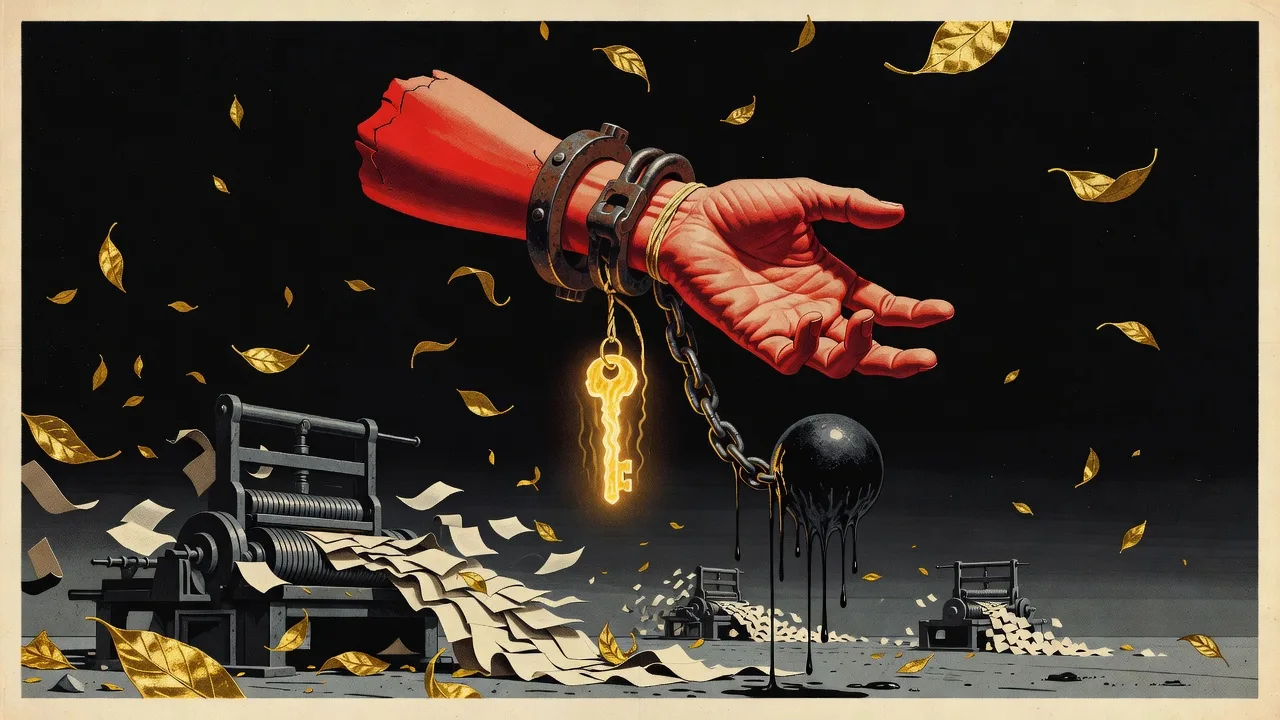
The word meant freedom from every master: state, boss, landlord, patriarch. Then it became the flag at the boss’s gate.
The Word
liberté. French for liberty. The suffix -aire: one who stands for, one who belongs to. Libertaire: the partisan of liberty. In English the same shape is -arian. So: a partisan of liberty. Sounds generous. Sounds American even. Hold that picture while we walk through the next century, because it is about to be stolen.
The word was minted by a worker in exile. Joseph Déjacque, poet, compositor, communist, fought on the barricades of 1848 in Paris and was driven across the Atlantic. From New York in 1858 he launched a newspaper and named it Le Libertaire, journal du mouvement social. He needed a word for a refusal with no loopholes, so he made one. He picked a French noun that already meant liberty and welded a partisan suffix to it. He could have called it anything. He called it the thing that had to be defended.
The name, before the theft, meant one thing: opposition to every relation of inequality and power. State, boss, landlord, patriarch. The state and the boss. The landlord and the patriarch. No carve-outs.
What It Wanted
Charity first. Read at its best, libertarianism is the most demanding definition of liberty ever drafted. It wanted a world without masters. Not fewer masters, not better masters, not masters you get to elect every four years and call that freedom. None. It refused the whole architecture of command: the law written by the few and obeyed by all, the deed that lets the idle collect from the active, the contract “freely” signed that ends with a clock and a foreman. It wanted the building torn down, not renovated, not repainted, not sold as a co-op with a doorman.
Honest people chose it because they had felt both fists. In mid-century France the state banned workers from assembling, striking, unionizing, and the boss paid the police to keep it that way. Liberal “liberty” meant liberty of trade: the boss’s liberty to buy labor cheap. The word was born as the answer to that lie: freedom meant the worker too, or it meant nothing at all.
Four convictions carried the first school:
1. No state. No king, no parliament, no police. No one who commands and no one who obeys on someone else’s say-so.
2. No private monopoly on the means of life. Anarchist communism: the tools belong to those who use them. Nobody owns the ground you stand on. And note: possession (the worker using the bench, the room, the loom) is not the same thing as property (the deed that lets a stranger charge rent for someone else’s labor). The first school knew that distinction cold. We will come back to it, because Rothbard lost it on purpose.
3. No power hiding in a contract. The wage relation is a master with a handshake, and the state’s courts enforced it. “Voluntary contract” with the only buyer in town is voluntary the way a mugging is voluntary when you hand over the wallet.
4. Equality is the precondition of freedom. Freedom for some is a chain for others. It is why Déjacque broke with Proudhon, the father of anarchism, over the small property and the hearth: an anarchism that leaves the husband in charge of the wife was not anarchism. It was just the household with extra steps. Déjacque called the half-measure what it was. History records that Déjacque was right.
That last point deserves a sentence for Proudhon. The man invented the doctrine’s vocabulary, declared “property is theft,” and built the frame that every anarchist after him used. He also stopped one step short of the cliff. The hommage is owed and the critique is honest: he started the war; Déjacque and the women he worked with had to finish it.
Why It Mattered
Because the nineteenth century had built a new species of mastery wrapped in the language of liberty, and the official philosophy refused to name it. The state was one master: taxes, conscription, censorship. The factory gate was a second one. The liberal answer, freedom of contract, was a magician’s trick; the contract was free in form, fixed in fact. The worker could refuse to sign and starve.
The wage is the most efficient master ever invented. It needs no whip. The worker polices himself for fear of the door. Freedom that stops at the factory gate is half-freedom at best, a stage set painted on the back. The word libertarian was coined to name the missing half: no state over you, no boss, no power you did not choose and cannot leave.
The question the first school answered, and the only one worth answering: what if liberty meant the end of mastery, all of it? Not what if the state were nicer. Not what if the boss paid better. What if neither had you.
The First School
Joseph Déjacque, 1858. A worker-poet in exile, he produced Le Libertaire, journal du mouvement social from New York until 1861, the first anarchist-communist newspaper anywhere on Earth. The word he coined was defined by what it opposed: the state, property, the wage, the patriarch. In 1857 he had broken with Proudhon over exactly this, a liberty with exceptions was a chain with ornaments.
The doctrine was precise: no rulers and no owners. Opposition to all relationships of inequality and power, not the state alone but the whole structure at once. That is why “libertarian” and “anarchist communist” were the same word in his pages. The enemy was the relation itself: one human holding power over another, under any contract, in any uniform, under any deed.
What Happened
The hijacking was American, twentieth century, and it was surgical. By mid-century America’s free-market anti-statists had a branding problem. “Liberal” was gone to the welfare state. “Anarchist” came with the bomb-thrower caricature. Murray Rothbard and his circle needed a word with anti-state voltage, so they took the one the anarchist left had used for a century. In Europe libertaire never stopped meaning communist anarchism; the Spanish CNT–FAI called itself libertarian communist into the 1930s, and got the word back by trying to build the thing. In America the word meant something else before the ink on the pamphlets dried.
Here is the theft in one move: they kept the anti-state charge and dropped the anti-capitalist half. Rothbard’s project was property absolutism: private property as a natural, absolute right, and the unregulated market as final judge. The word that meant “no masters” became the slogan for the biggest master of all. Where Déjacque opposed every relation of inequality and power, the squatter sanctified the single greatest one: the ownership of everything by a few.
Now watch the second move, because it is the one that makes the theft complete. Rothbard needed property, the deed, the title, the absentee landlord’s claim, to be absolute. But the original distinction, the one Proudhon spelled out and Déjacque carried forward, was that property and possession are not the same thing. Possession is the worker in the workshop, the family in the home, the loom in the hands of the weaver; use it, occupy it, defend it, that is the right. Property is the deed that lets someone miles away charge rent for the work happening in it. The anarchist tradition: possession yes, property no. Rothbard’s “libertarianism” inverted this at the root. It elevated property to a natural right and called the inversion a defense of liberty. The word that was coined to abolish the deed became the brand that worships it.
And the irony compounds. American “libertarians” were not even consistent anti-statists. They wanted the state abolished when it protected workers, and deployed when it enforced property. Police, courts, contract law, corporate charters, bailouts: the squatter’s state is small for everyone but the deed-holder. Déjacque opposed the state and the boss together. Rothbard opposed the state and kept the boss. They are not quarreling cousins; they are the same crime, half confessed.
The Verdict
Libertarian = anti-state, anti-capitalist, left-wing. Freedom from every relation of inequality and power. American “libertarianism” is a semantic hijacking: property absolutism wearing a word that means its opposite.
The first school wins. The market already has a word for the Rothbard program: capitalism. Do not wear the uniform of the resistance while manning the boss’s gate.
The Door
Can they leave?
A liberty you can exit is real. The first school’s freedom had the door built in by design: no state you cannot leave, no contract you cannot quit, no workplace that owns your future. The cooperative is honest because its member can walk out with reputation intact.
Now the hijackers, and the irony is the verdict in miniature. Property absolutism makes the door swing for one side only. Capital is mobile: the corporation can leave town overnight, the portfolio can leave the country in a keystroke. The worker’s door swings shut: non-compete clauses, debt, health care tied to a job, a “free market” where freedom of contract means signing the only offer on the table. They gave the exit right to the deed-holder and confiscated it from the person who works.
AnCaps love to object here, and the objection collapses on the use-criterion. The libertarian tradition does not grant the boss the deed because the boss signed a paper. It grants possession to the user. The factory you work in is yours while you work in it; the apartment you live in is yours while you live in it; the ground you farm is yours while you farm it. Title from the state, the LLC, the inheritance, none of those generate the right. Use generates the right. When you stop using it, you stop having the right. That is the test. Run it on absentee ownership of a Manhattan tower and watch the title evaporate. Run it on a worker inside the building and watch the right appear. The whole Rothbardian program fails this test because it never measured right by use in the first place; it measured right by paper.
And where does the bossless-state road end? You have already seen the destination; it has a name now. Techno-feudalism. Keep the boss, delete the state, and the boss becomes the state: the platform that sets your terms, the app that holds your ratings, the company town with better branding. The barons of the thirteenth century at least called their courts what they were. The digital baron calls his serfdom a user agreement, and the terms of service update while you sleep. Déjacque saw the whole architecture in 1858: the state and the boss are one relation wearing two coats. Keep one, and the other regrows like a weed, because power abhors an unclaimed master. This dispatch has its own autopsy, Adobe as the canary: The Return of Techno-Feudalism.
That was the doctrine the first school existed to abolish. A freedom that locks someone else’s door is not freedom; it is a key. So the test this court hands to every libertarian: can the person at the bottom of the relationship leave it? If the boss can walk and the worker cannot, that was never liberty; it was property wearing a word that meant the opposite. Déjacque’s word meant the opposite. He gets it back.
Series: The Etymological Court · Previous: Anarchism · Next: Agorism