The Eighteen-Hour Window: GrapheneOS, Richard Medhurst, and Why Sovereign Mobile Is Not Optional
A British journalist arrested under terrorism law had his phone seized by anti-terror police. They never got in. The mechanism that saved his sources is the same mechanism every sovereign individual needs, and the one Libertaria must build on.
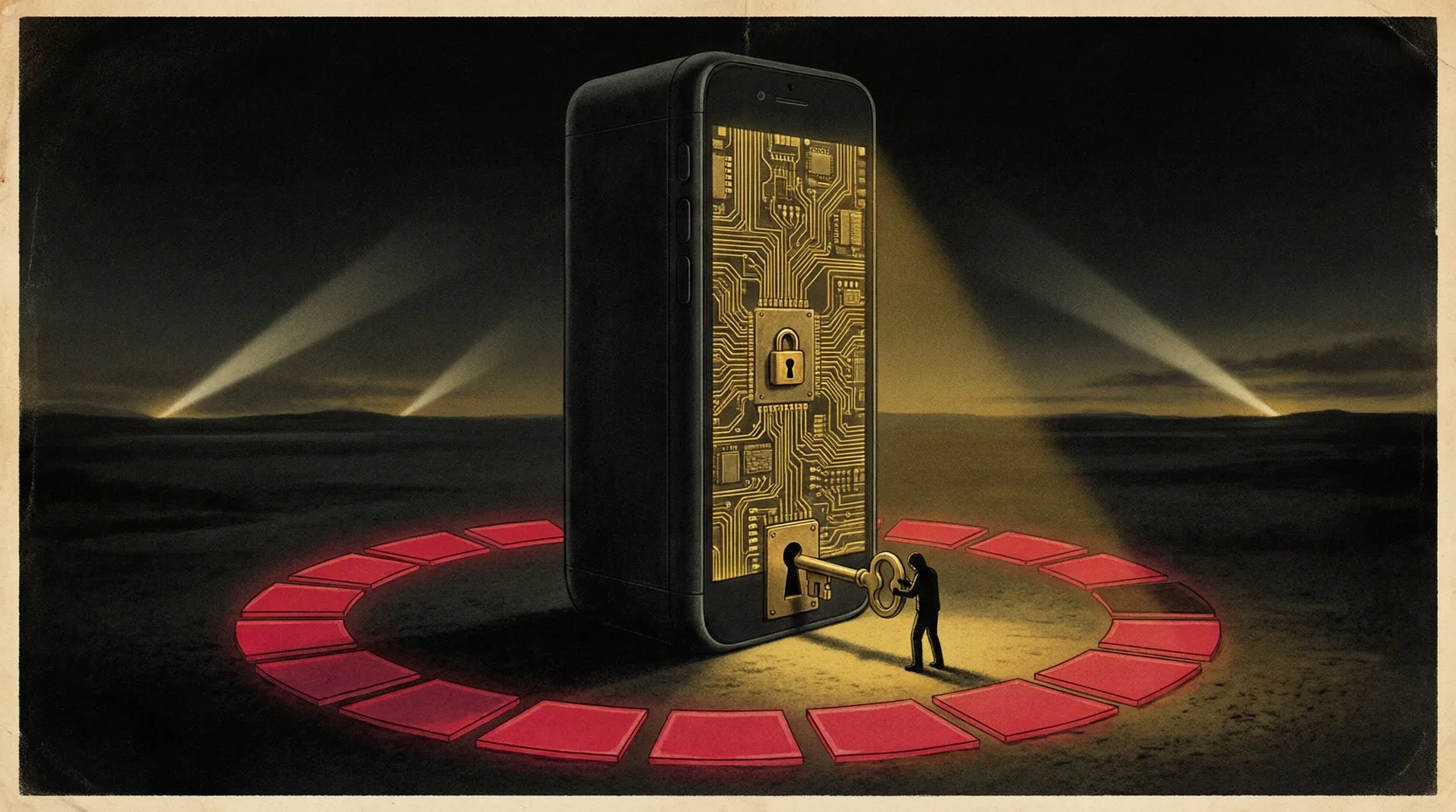
Subject: Richard Medhurst, independent British journalist. Arrested August 2024 at London Heathrow under Section 12 of the Terrorism Act 2000. The first reporter detained under this provision. His devices were seized. Two phones, microphones, headsets, cables, a Faraday bag. Everything. A few months later, Austrian security services raided his Vienna apartment. The British investigation closed October 2025 with no charges. The Austrian investigation remains open.
He is writing a multi-volume cybersecurity manual for high-risk journalists.
His GrapheneOS device held. The police never got in.
The seizure
They came onto the aircraft. That is the detail that matters. Not a border checkpoint, not a back room. Officers entered the plane before passengers deplaned, took him by surprise, and snatched the locked phone from his hands before he could power it down. Detained for nearly a full day. Interrogated for two hours. Every device, every cable, every adapter seized.
Medhurst had two phones: a Pixel 7 Pro running GrapheneOS, compartmentalised into multiple isolated user profiles, and an iPhone used for recording interviews. The GrapheneOS device carried his work. Contacts, communications, sources. The kind of data that, if extracted, identifies every person who ever spoke to him confidentially.
The right to protect journalistic sources has been confirmed by the European Court of Human Rights in numerous rulings. It is also the right that dies first when a phone falls into state hands and the state has forensic tools.
After First Unlock
A phone lands on a metal table in a detention room. The screen is dark. The passcode has not been entered since the last reboot. That phone is a brick of ciphertext. The forensic team can image the disk, dump the flash, run every tool Cellebrite sells. The keys are not in memory. They cannot be extracted because they are not there.
Then someone types the passcode. The phone wakes up. Apps reload. Notifications arrive. And the encryption keys move into RAM, where they stay until the phone powers off or reboots. This is the moment the forensic industry is built for.
Here is the mechanism every journalist, activist, and sovereign individual must understand.
A modern smartphone has two fundamental states.
Before First Unlock (BFU): the device has been powered off or rebooted, and the passcode has not yet been entered. The encryption keys are not in memory. All user data on disk is fully encrypted. Forensic tools cannot extract the keys from RAM because the keys are not in RAM. This is the most secure state.
After First Unlock (AFU): the user has typed the passcode at least once since boot. The encryption keys are now loaded into device memory. The phone is usable. Apps run, notifications arrive, calls come in. But the keys can be extracted by actors with physical access and the right tooling. Cellebrite, Magnet, GrayKey: the forensic industry sells machines designed to pull keys from AFU devices.
Police always try to obtain a device while it is in AFU mode. In Medhurst’s case, they snatched the locked phone from his hands. Locked, but still in AFU. The screen was off, but the keys were in memory.
This is where the eighteen-hour window enters.
The reboot
Imagine a timer running silently in the phone’s firmware. No network connection required. No user interaction. Just a countdown. If the correct passcode is not entered within the configured window, the phone reboots. Medhurst set it to eighteen hours.
When the auto-reboot fires, the device drops from AFU to BFU. The keys leave memory. The data on disk returns to fully encrypted. Every forensic tool that depends on extracting keys from a running session fails.
Medhurst’s phone rebooted while in police custody. By the time forensic teams accessed it, it was in BFU. They had a powered-off brick of ciphertext.
To his knowledge, and mine, this is the first publicly recorded instance of the auto-reboot feature saving a journalist’s sources against a state actor in a real-world seizure. Not a thought experiment. Not a conference demo. A man in a detention room whose sources survived because his OS counted down eighteen hours and pulled the keys.
What GrapheneOS actually does
Somewhere in a server room or a forensic lab, an analyst stares at a dump of encrypted flash storage and sees nothing. Thirty-two gigabytes of noise. The device they pulled from a suspect’s pocket has been talking to them for months, and now it is silent. This is the surface GrapheneOS builds.
GrapheneOS is a ground-up hardening of the AOSP base. It is not a privacy skin over Android. Founded by Daniel Micay in 2014 and endorsed by Edward Snowden in 2019. The objective, as Medhurst describes it, is simple: take advantage of secure consumer hardware. The Titan M2 security chip. Hardware memory tagging. The verified boot chain. And do it without trusting the vendor’s software layer. Wipe the factory OS. Install a stripped-down, hardened Android where each app is isolated, every tracking telemetry channel is disabled, and the attack surface shrinks to what you actually need.
The hardening surface, based on Medhurst’s deployment and expert commentary:
| Feature | What it does | Adversary it blocks |
|---|---|---|
| Auto-reboot (18h default) | Returns device to BFU after inactivity window | Forensic key extraction from AFU memory |
| Isolated user profiles | Compartmentalises apps and data into separate encrypted containers | Cross-app data correlation; single-breach cascade |
| Biometric 2FA | Fingerprint unlock requires an additional 4–6 digit PIN, separate from the main passcode | Forced biometric extraction (physical finger press) |
| USB port disable | Completely disables the USB data port, including while charging | Physical tampering, forensic cable injection |
| Scrambled PIN layout | Randomises the on-screen keypad positions | Shoulder-surfing, CCTV capture of passcode entry |
| Hardware memory tagging | Tags every memory allocation; blocks buffer overflow exploits at the silicon level | Remote exploitation via RAM corruption (Pegasus-class) |
| No Google services by default | Strips Play Services, telemetry, and tracking infrastructure | Google-side data collection, Prism-class programs |
Steven Murdoch, professor of security engineering at UCL, puts it precisely: he would not call the hardware impossible to crack, but even the best forensic software currently available is incapable of obtaining data from GrapheneOS devices without the passcode. Particularly if the device has been freshly rebooted. The key qualifier is particularly. BFU is not a marketing claim. It is a state machine transition that the forensic industry has not solved.
GrapheneOS disables the user-tracking features that Google retains to support its business model and that of its partners. Its users prioritise security over convenience. Its business model does not depend on user tracking. That last sentence is the one that matters most.
The notification trap
You send a message. It vanishes. You feel safe. Then someone pulls the notification log off the phone and reads the preview that was sitting in plaintext the whole time.
End-to-end encryption in the messaging layer is necessary but insufficient. Harlo Holmes, director of digital security at the Freedom of the Press Foundation, demonstrated that disappearing messages can be recovered by hacking the notification system. Even though message content is encrypted inside Signal or WhatsApp, the notification preview sits in the device’s notification database in plaintext. “X wants to talk at 3 o’clock.” Forensic tools read the notification database, not the encrypted vault.
The three dots that appear when someone is typing. Telemetry data. Metadata. Extractable. Especially from WhatsApp.
The phone is not your friend. The OS layer between the encrypted app and the hardware determines whether your encrypted app actually protects you. GrapheneOS closes the gap between the app’s promise and the OS’s behaviour by stripping the intermediary that leaks.
This is why a hardened OS matters more than which messaging app you chose. The app is a vault inside a building. If the building’s doors are open, the vault’s lock is academic.
Medhurst’s only mistake
Turning off his phone before landing is precisely what Medhurst failed to do. He did not expect police to board the aircraft. From a strictly technical standpoint, that was his only operational oversight. If the phone had been powered off at the moment of seizure, already in BFU, the auto-reboot feature would have been redundant. The keys would never have been in memory.
But this is the lesson: you do not get to choose when the state boards your plane. You build systems that protect you even when you fail to execute the optimal protocol. The eighteen-hour auto-reboot is a safety net for the moment vigilance is not enough.
Medhurst refused every police request for his passcode over months. They offered “journalistic privilege.” An independent officer would hold the password, sift through privileged material, and decide what to pass to prosecution. He refused that too. If they had cracked the encryption, they would not have spent months begging for a password.
Why MosaicOS, and why now
GrapheneOS proves the thesis. Consumer hardware can be secured against state-level forensic capability if the OS layer is rebuilt with sovereignty as the design constraint. The hardware is not the problem. The vendor’s software stack is the problem. The telemetry. The tracking. The cloud entanglement. The business model that monetises your behaviour.
This is the opening for derivative work.
MosaicOS, and projects like it, build on the GrapheneOS hardening base and add what GrapheneOS does not provide: a sovereign identity layer, a trust network, a way to bind device security to social and cryptographic infrastructure that the user controls rather than a vendor. GrapheneOS secures the device. The next layer secures the relationships, the credentials, the verifiable attestations that let individuals prove who they are without handing proof to a centralised authority.
The Mosaic Trust Network already builds trust graphs. Peer-to-peer identity verification. Reputation systems. Cryptographic attestations. Binding that trust layer to a GrapheneOS-class hardened mobile base is the logical architecture. Device-level security without identity-level sovereignty gives you a safe that no one can open but no way to prove the safe is yours. Identity-level sovereignty without device-level security gives you a passport printed on tissue paper.
You need both. The stack has to go from silicon to social.
Libertaria lens
A man sits in a detention room. His phone is in a plastic evidence bag, counting down. Eighteen hours from now, the phone will reboot. The keys will leave memory. Everyone who ever trusted him with a secret will still be safe. He does not know this yet. He is being interrogated.
Libertaria’s sovereignty doctrine is an infrastructure mandate. If the sovereign individual cannot communicate, transact, and verify identity on a device that resists state-level seizure, sovereignty is a word, not a condition.
Medhurst’s case is the proof point. A journalist arrested under terrorism law for his reporting. Sources protected not by legal privilege, which the state offered to “respect” and then circumvent, but by an OS feature that the state could not defeat. The right to protect sources, confirmed by the European Court of Human Rights, survived in practice only because a nineteen-year-old open-source project had built a better state machine than the British anti-terrorism command.
This is freedom of information infrastructure. Not the abstract kind. The kind where the eighteen-hour countdown starts and the keys leave memory and months of forensic effort fails.
The sovereignty response is the same one Medhurst arrived at through experience: use hardware whose security properties you can verify, strip the vendor’s software layer, compartmentalise everything, and accept that convenience is the price of sources staying alive. Then build the next layer on top of that hardened base. Identity. Trust. Credential. Attestation.
Signal / Noise
Signal: the BFU/AFU state machine, the auto-reboot-to-BFU mechanism, the first real-world proof that it saves sources against a state actor, and the six-feature GrapheneOS hardening surface. All verifiable, all operational, all deployable today on consumer hardware.
Noise: the “can a Google device ever be secure” debate. The hardware is not the adversary. The software layer between hardware and user is. Replace it. That is the entire insight.
Why it matters to Libertaria
MosaicOS as a GrapheneOS derivative is not a lifestyle product. It is the device layer of sovereign infrastructure. The same stack that NexusOS occupies at the OS level and that the Mosaic Trust Network occupies at the identity layer. The phone is where the state reaches the individual. The OS on that phone is where the individual pushes back.
Medhurst is writing his manual. We should be building the infrastructure his manual describes.
Verification status
Medhurst’s account: confirmed via his public statements. Expert commentary: Steven Murdoch (UCL) and Harlo Holmes (Freedom of the Press Foundation), both on record. The auto-reboot BFU mechanism: documented in GrapheneOS source since 2021. Apple iOS implemented auto-reboot in 2024. Standard Android followed in 2025. GrapheneOS was three years ahead. That three-year gap is where Medhurst’s sources survived.